
A university still publishes an old file-transfer service that no course uses. It is reachable from the internet and has failed two vulnerability scans. Which design change reduces the risk?
Select an answer to reveal the explanation.
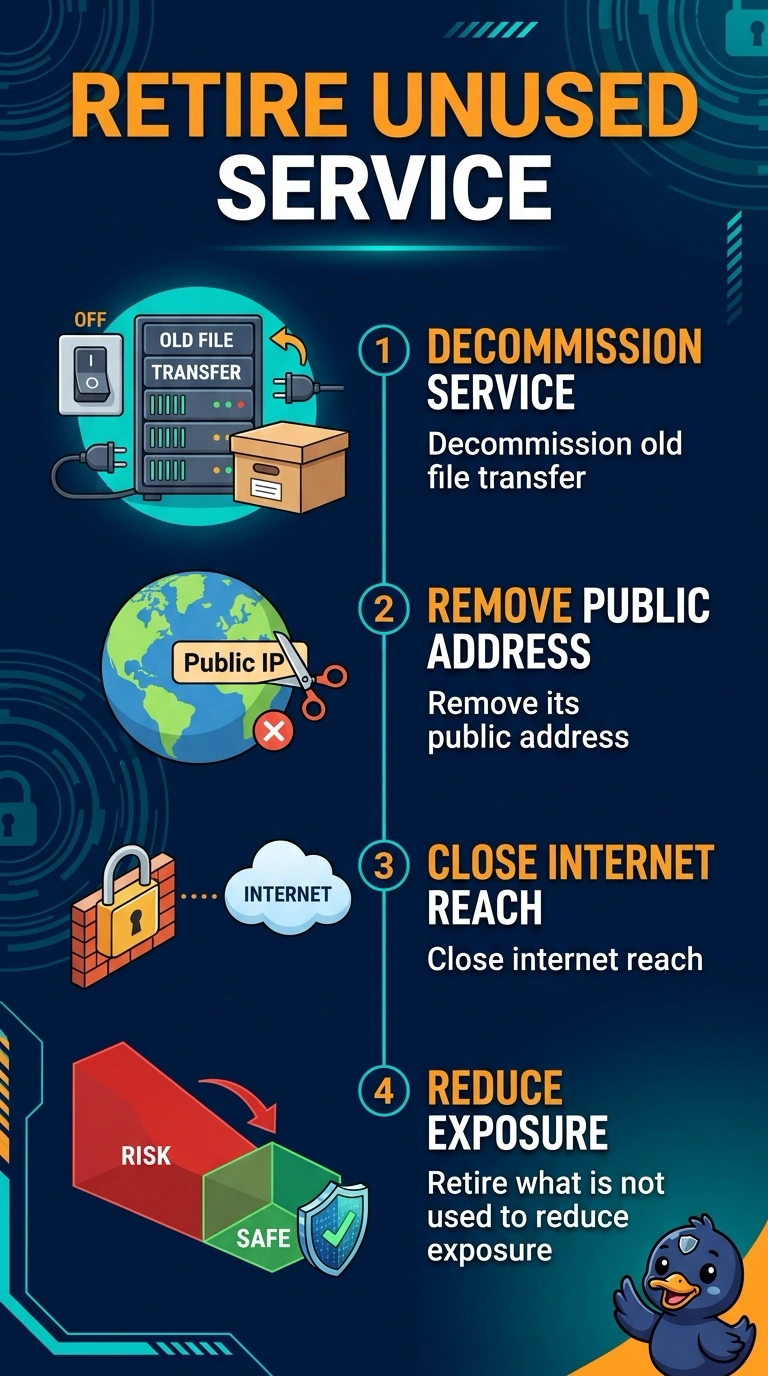
Short Explanation
An empty shop on a dark street is still a door. You close the service and you take the address off the internet. A note with no owner, a faster disk, or guest wireless leaves the door up.
Full Explanation
When a service has no business user, the clean risk treatment is to avoid the risk by removing it. Decommissioning the transfer service and deleting the public address ends the scan findings. Accepting it without an owner leaves the exposure. Hardware and guest wireless do not retire the service. Decommission the service and remove its public address is the design that meets this requirement. Leave the service up and add it to a risk-acceptance note with no owner is the wrong fit because an ownerless acceptance note does not remove an internet service nobody uses. Put a faster disk under the same public service is the wrong fit because a faster disk keeps the vulnerable service on the same public address. Add a guest wireless network and leave the file-transfer service as it is is the wrong fit because guest wireless is unrelated to the public file-transfer exposure. Exam caveat: Confirm no hidden job still uploads grades or backups before you delete the address. Avoidance is right only when the business use is actually gone. Operational check: After removal, scan the old address from outside and confirm it does not answer, and confirm no course schedule still names the service.