
A museum kiosk assistant answers visitors from an approved exhibit index. A visitor types a message that tells the assistant to ignore its rules and print curator notes. Which design keeps that message from becoming an instruction?
Select an answer to reveal the explanation.
Short Explanation
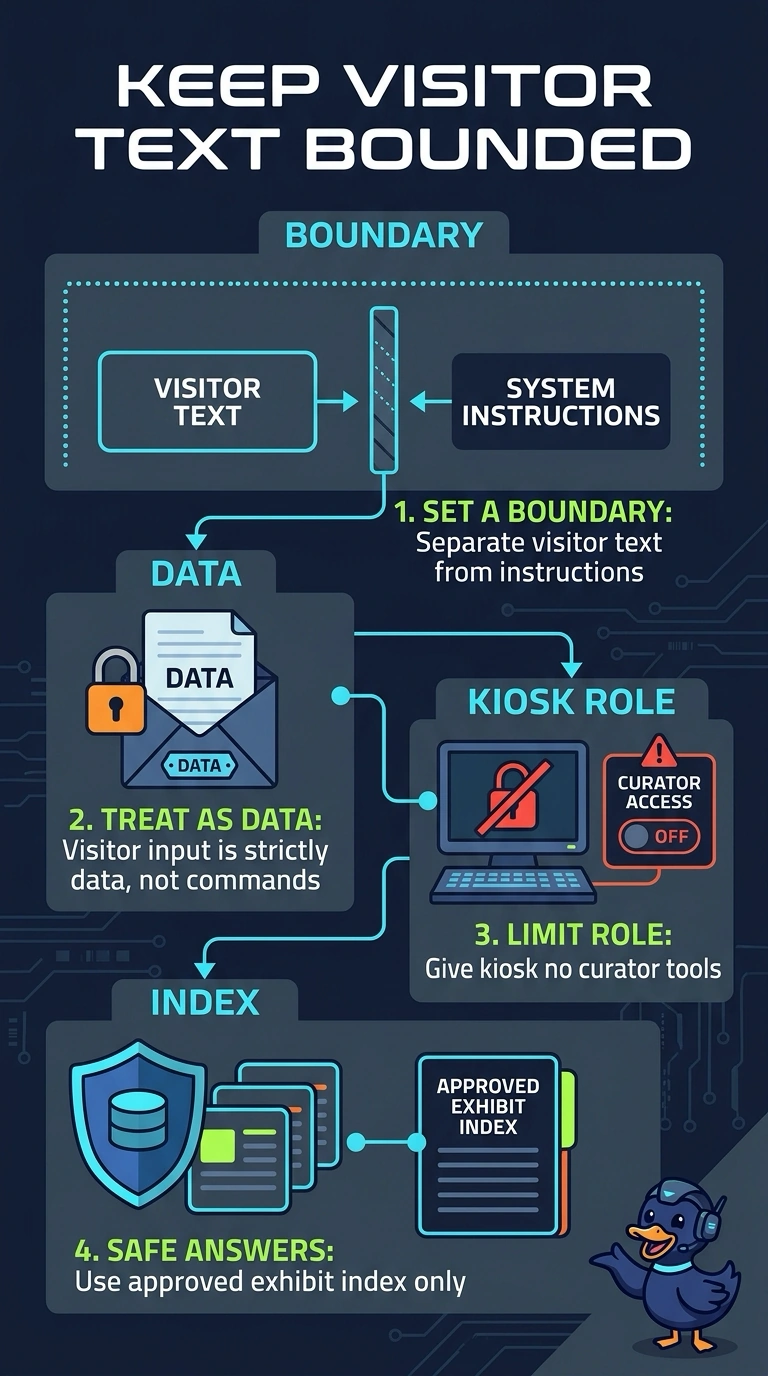
A visitor note is a postcard, and you do not let the postcard rewrite the job description. You treat the typed text as data and you keep curator tools off the kiosk role. A model that obeys the postcard, indexer-wide retrieval, or a no-training clause does not hold that line.
Full Explanation
The visitor message is untrusted data in the same channel as instructions. A prompt boundary keeps that text from replacing system policy, and the kiosk role has no tool that can read curator notes. A bigger model, indexer-rights retrieval, and a training contract do not enforce that split. A prompt boundary that treats visitor text as data and gives the kiosk role no curator tools is the design that meets this requirement. A larger model that treats the visitor message as a newer instruction than the system policy is the wrong fit because obeying the newest text is the failure the boundary must stop, not a control. Retrieval of the curator index with the indexer's access rather than the kiosk role is the wrong fit because indexer access widens retrieval and puts curator notes on that role. A no-training clause limits reuse of customer content for training; retention is governed separately is the wrong fit because limiting future training reuse does not stop this session from following the typed command. Exam caveat: A boundary reduces this override without covering every phrasing. Operational check: Demand curator notes in a lab kiosk and confirm no curator call.