
A food bank's donor service moves across cluster nodes during the day, and only that service may call the inventory API. Which design keeps the allow correct when the pod moves?
Select an answer to reveal the explanation.
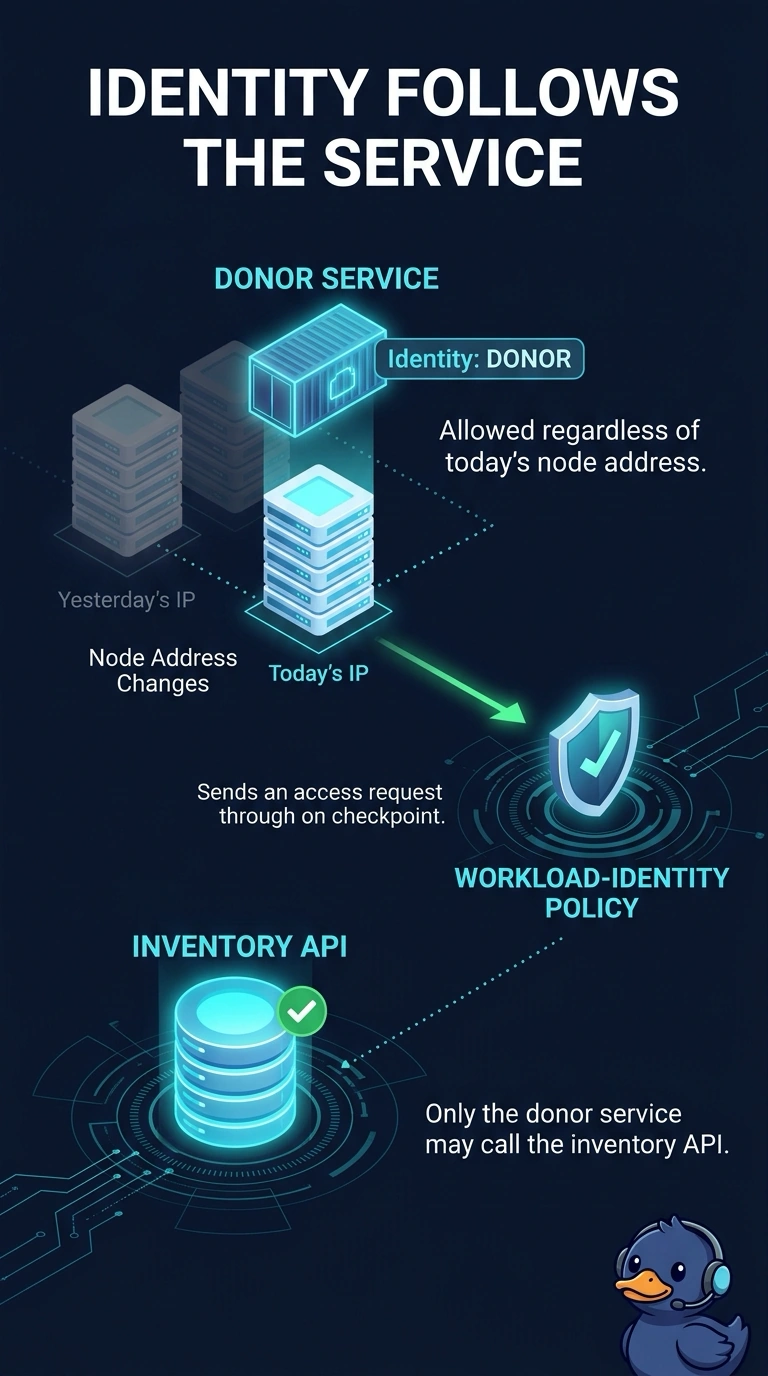
Short Explanation
A name tag still works when someone changes desks, while yesterday's desk number does not. You allow the donor service by its identity, not by the node it used last. A stale node address, a perimeter allow, or a virtual-machine security group misses a pod that keeps moving.
Full Explanation
Pod addresses change when the scheduler moves work, so a rule tied to yesterday's node either blocks a healthy move or allows whatever lands on that node next. A workload identity stays with the donor service across moves, and the mesh or network policy can allow only that identity to call inventory. The call does not cross the internet perimeter, and the pods do not present a guest interface a virtual-machine group can bind. A workload-identity policy that allows the donor service regardless of today's node address is the design that meets this requirement. A static firewall rule for the node address the donor pod used on the previous day is the wrong fit because yesterday's node address is stale as soon as the scheduler places the donor pod somewhere else. A perimeter allow from the internet to the cluster load-balancer address is the wrong fit because the inventory call stays inside the cluster, so an internet perimeter rule does not see it. A virtual-machine security group on a guest interface these pods do not have is the wrong fit because these pods have no guest interface, so a virtual-machine group does not attach to the inventory call. Exam caveat: Identity policy only helps if every call presents that identity, so a sidecar or mesh that can be bypassed on the node is still an open path. Operational check: Move the donor pod to a different node, call inventory, and confirm the allow still matches the service identity while a marketing pod on the old node is denied.