
A bank's application tier and database tier are virtual machines on one hypervisor cluster. Captures show the application tier is not the only guest opening the database port. The perimeter firewall logs none of those sessions. Which design segments them?
Select an answer to reveal the explanation.
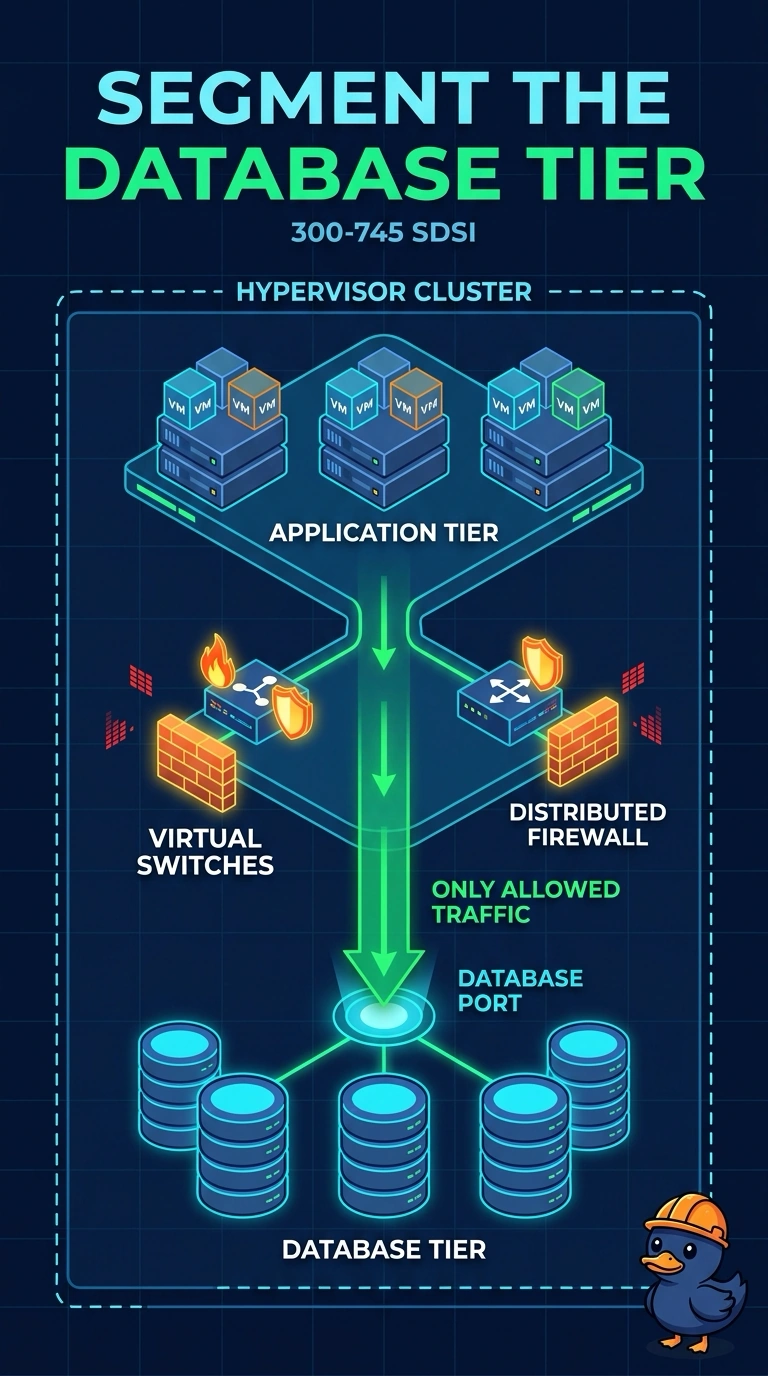
Short Explanation
The hallway camera at the front door never films a conversation between two offices. You enforce on the virtual switch and you allow only the application tier to the database. A tighter edge rule, a flat VLAN, or the marketing site's web firewall is pointed the wrong way.
Full Explanation
East-west traffic between guests is invisible to the internet edge. A distributed firewall on the virtual switch can enforce, per guest, that only the application tier opens the database port. That is the segmentation point that can see the packets. A shared VLAN keeps the flat path. The marketing site's web firewall is a different application. A distributed firewall on the virtual switches that allows only the application tier to the database port is the design that meets this requirement. A stricter rule on the internet edge, which these sessions never cross is the wrong fit because the captures show the sessions stay inside the cluster, so an internet-edge rule never evaluates them. One VLAN that contains both tiers with no filter between the guests is the wrong fit because a shared VLAN with no filter is the flat east-west path the captures already recorded. A web application firewall on the public marketing site is the wrong fit because the marketing site is not the database port the other guests are opening. Exam caveat: A distributed rule that names a guest by an address the guest can change will be bypassed. Tie the rule to the workload identity the platform asserts. Operational check: From a lab guest that is not the application tier, confirm the database port fails, and confirm the application tier still connects. Check that the internet-edge log stays empty for that test.