
A museum's ticketing application is falling behind because every application server spends most of its time on TLS handshakes. The tickets themselves are not secret from the museum's own edge. Policy permits plain HTTP on the isolated edge-to-server hop. Which change protects the application flow and frees the servers?
Select an answer to reveal the explanation.
Short Explanation
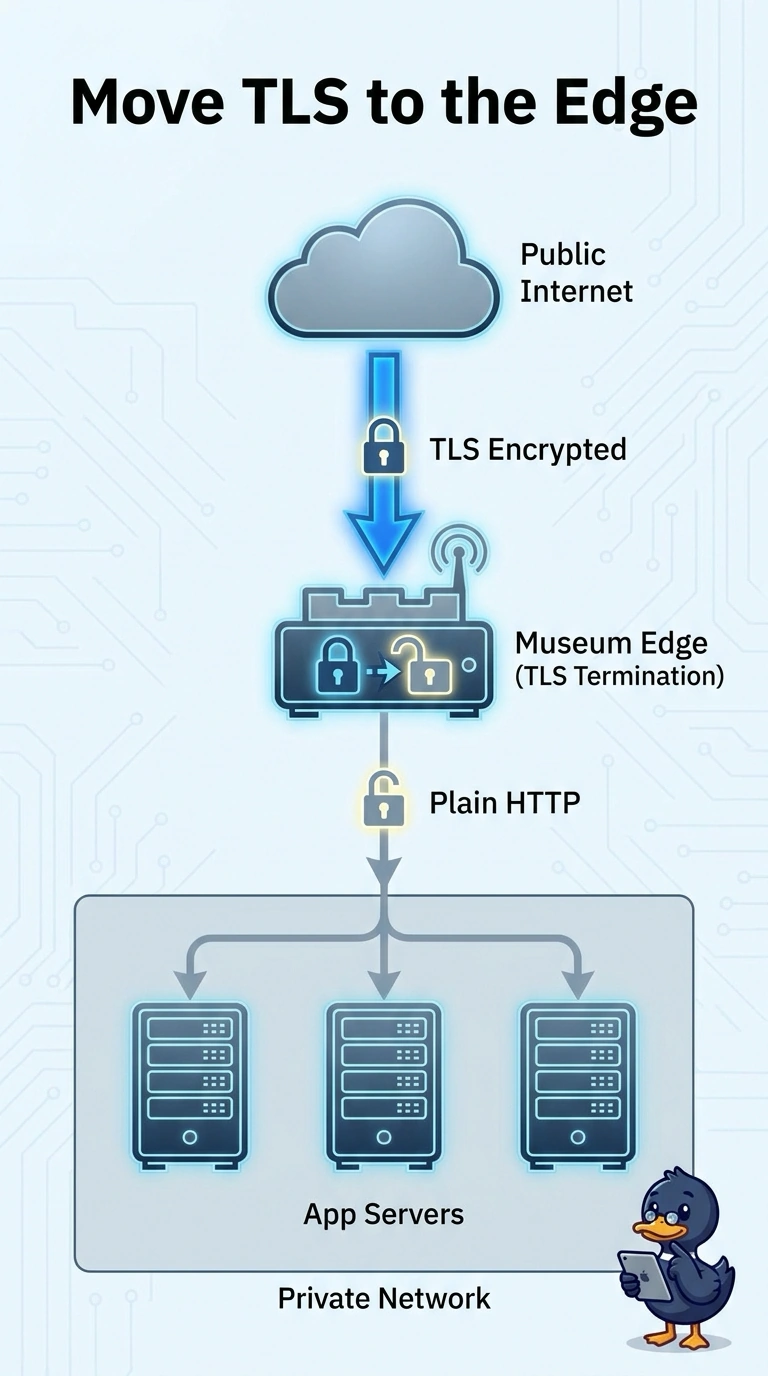
The servers are tired from unlocking the door for every visitor. You unlock it once at your own edge and you keep the inside hallway private. Staff-web decryption, a host firewall that still terminates TLS, or an agent on a visitor's phone does not lift that work.
Full Explanation
The flow problem is where TLS ends. The servers are doing handshake work the museum is willing to do at its own edge, and the remaining hop stays on a private network. Offload the client TLS handshake at the edge and restrict backend HTTP to that isolated hop, which removes the CPU cost without publishing the application servers. Decrypting staff web use, filtering hosts that still terminate TLS, or deploying unmanaged agents leaves the handshake where it is. TLS offload on the museum edge, with plain HTTP only on the private hop to the servers is the design that meets this requirement. TLS decryption of staff browsing so the proxy can read unrelated websites is the wrong fit because staff browsing is a different flow and does not remove the handshake load. A host firewall on each ticketing server that still terminates the public TLS is the wrong fit because a host firewall does not move the handshake off the server that is still terminating TLS. An endpoint agent on visitor phones that the museum does not manage is the wrong fit because visitor phones are unmanaged, and an agent there does not spare the server CPU. Exam caveat: The private hop must stay private. Operational check: Compare server CPU with offload on, and confirm an external scan sees the edge certificate.