
A hospital SOC wants help after a phishing incident. Written policy lets a model draft text and queries. The same policy forbids the model from disabling accounts, deleting firewall rules, or changing routes. Which use fits?
Select an answer to reveal the explanation.
Short Explanation
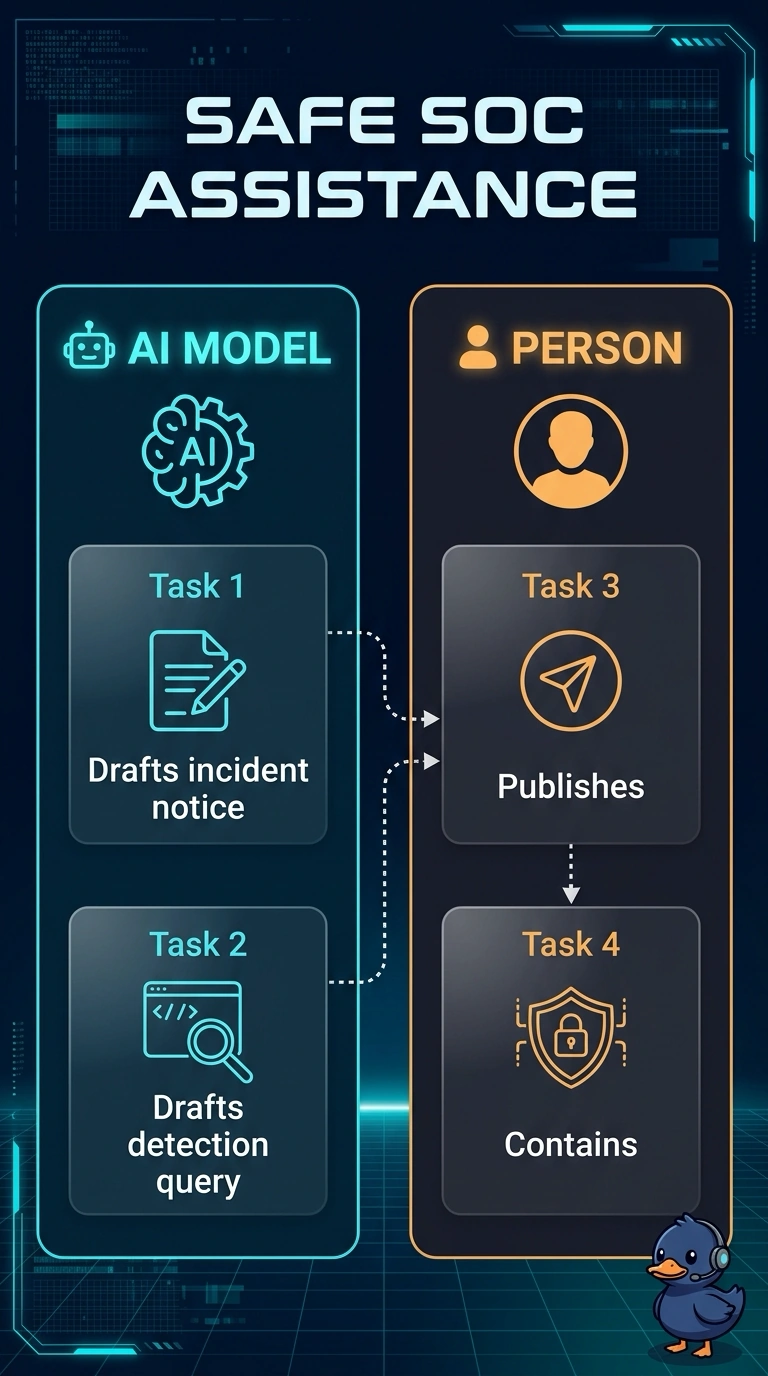
A junior may write the memo and may not touch the breakers. You let the model draft the notice and the query, and you keep a person on publish and containment. Disabling mailboxes, deleting firewall rules, or pushing a route crosses the line the policy drew.
Full Explanation
The written policy draws a line between drafting and acting, and a notice plus a detection query are drafts a person can edit, publish, or run after review. Disabling accounts, deleting firewall rules, and pushing routes all change production, which the policy does not hand to the model. The fit is the draft alone, with a person still on every disruptive step. Draft the incident notice and a detection query, and leave publish and containment to a person is the design that meets this requirement. Disable every mailbox that appears in the phish, with no person on that action is the wrong fit because disabling mailboxes is a disruptive identity action, and the written policy keeps that decision with a person. Delete firewall rules the model marks as unused, with no change review is the wrong fit because deleting firewall rules changes the live path, and the policy does not let the model commit that change. Push a black-hole route for the suspected network, with no engineer applying it is the wrong fit because pushing a route is a live network change, and the policy reserves that action for an engineer. Exam caveat: If a later policy allows one bounded containment step, that step has to be named in writing, and this policy does not name any such step for the model. Operational check: Run the model on a lab phish and confirm it produces a draft notice and a draft query, and confirm it has no credential that can disable an account or change a rule.