
A transit agency already alerts on a bad sign-in, keeps the response steps in a written playbook, and defines its network in code. The firewall can be changed only by hand in a console. Which element is missing?
Select an answer to reveal the explanation.
Short Explanation
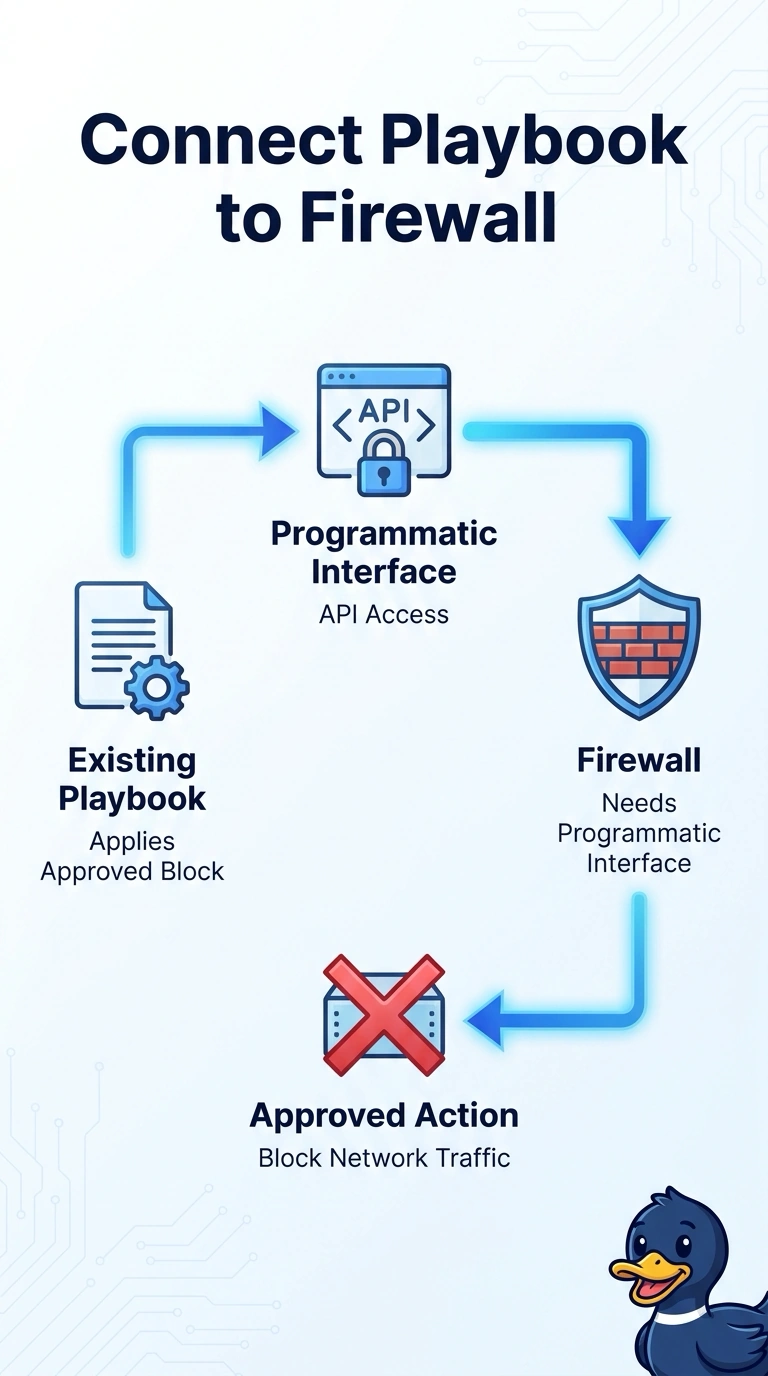
The recipe is written and the bell rings, and the stove still has no switch you can reach. You give the firewall an interface the existing playbook can call. Another page, a container scan, or a second copy of network code does not add that switch.
Full Explanation
The response steps and the alert already exist, and the network is already expressed as code. The gap is at runtime: the playbook cannot change the firewall because the firewall exposes no programmatic interface. Adding another page, scanning a container image, or duplicating the network code leaves the console as the only way to apply the block the playbook describes. A programmatic interface on the firewall so the existing playbook can apply the approved block is the design that meets this requirement. Another alerting rule for the same sign-in event the agency already pages on is the wrong fit because the sign-in alert already pages the on-call, so another rule does not let the playbook change the firewall. A container image scan in a pipeline that is not part of this incident response is the wrong fit because an image scan looks at a build artifact and does not give the playbook a way to update the firewall. A second copy of the network code the agency already uses to define the network is the wrong fit because the network is already defined in code, and that code does not provide a runtime call for this response. Exam caveat: An interface the playbook can call still needs the same approval the console change uses, or the automation becomes a second unreviewed path. Operational check: In a lab, invoke the firewall interface from the playbook and confirm the approved block appears, then confirm a console-only rule is not required to finish that step.