
A transit agency already monitors and alerts on its cloud network, and engineers still click routes into the console with no review. Which missing element puts those changes under review?
Select an answer to reveal the explanation.
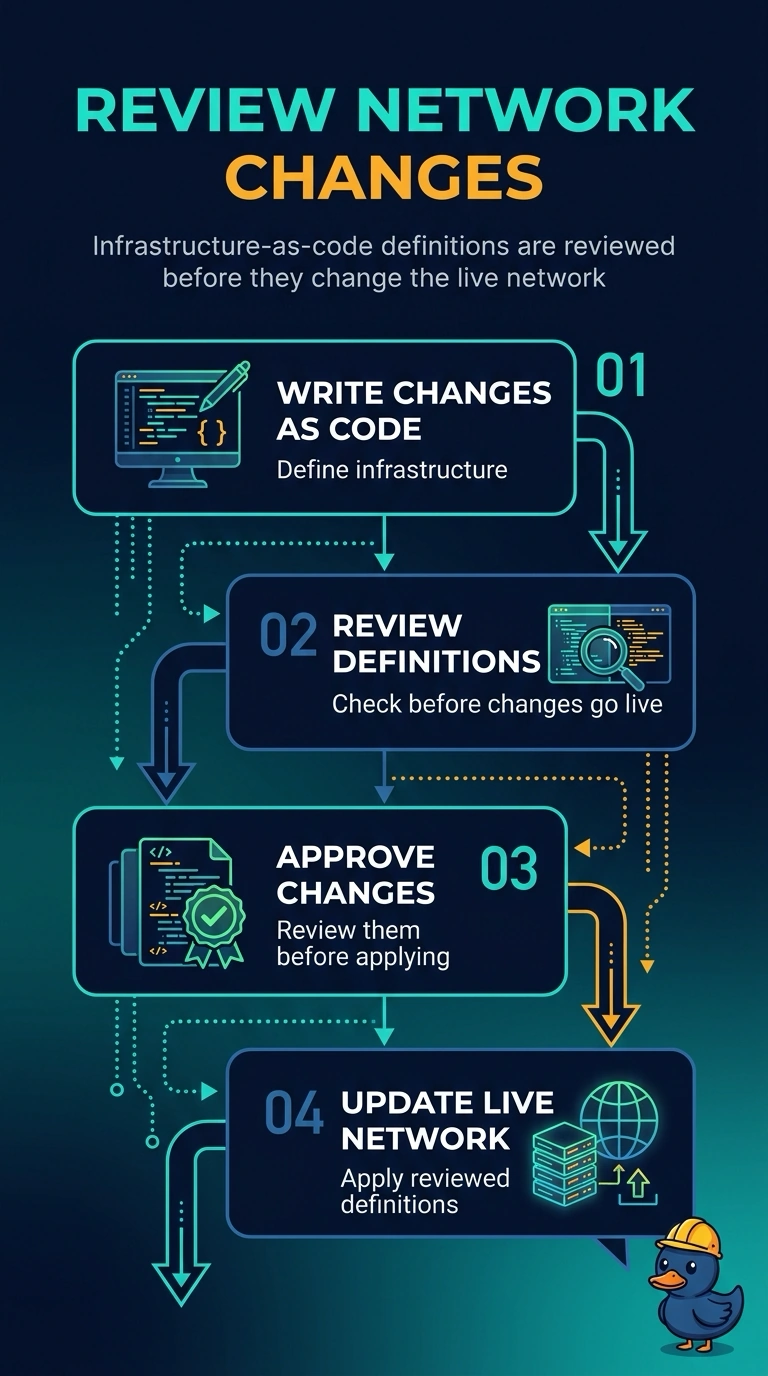
Short Explanation
Clicking a route by hand leaves the next crew with no drawing to review. You describe the network as code and review that definition before it is applied. Another chart, an image scan, or a laptop-isolation playbook does not review the route change.
Full Explanation
Monitoring and alerting are already present, so another chart does not create a review. The missing element is a definition of the network that can be read, reviewed, and then applied, instead of a click in the console that has no diff. Image scanning belongs to a build pipeline this change does not use, and an endpoint playbook does not carry a route into the cloud network. Infrastructure-as-code definitions that are reviewed before they change the live network is the design that meets this requirement. Another monitoring chart of the same routes the agency already watches and alerts on is the wrong fit because more charts repeat telemetry the agency already has and do not review the proposed route change. A container-image scan for a pipeline that does not build or promote images is the wrong fit because an image scan inspects containers, and this gap is a hand-built console change to the network. An orchestration playbook that isolates laptops and does not change network routes is the wrong fit because a laptop playbook contains an endpoint and does not submit or review a network route change. Exam caveat: Reviewed code still needs a pipeline that applies the reviewed revision, or an engineer can approve one file and then click a different route into the console. Operational check: Open a test route change as code, confirm a reviewer must approve it before apply, and confirm the console shows the route only after that approval.