
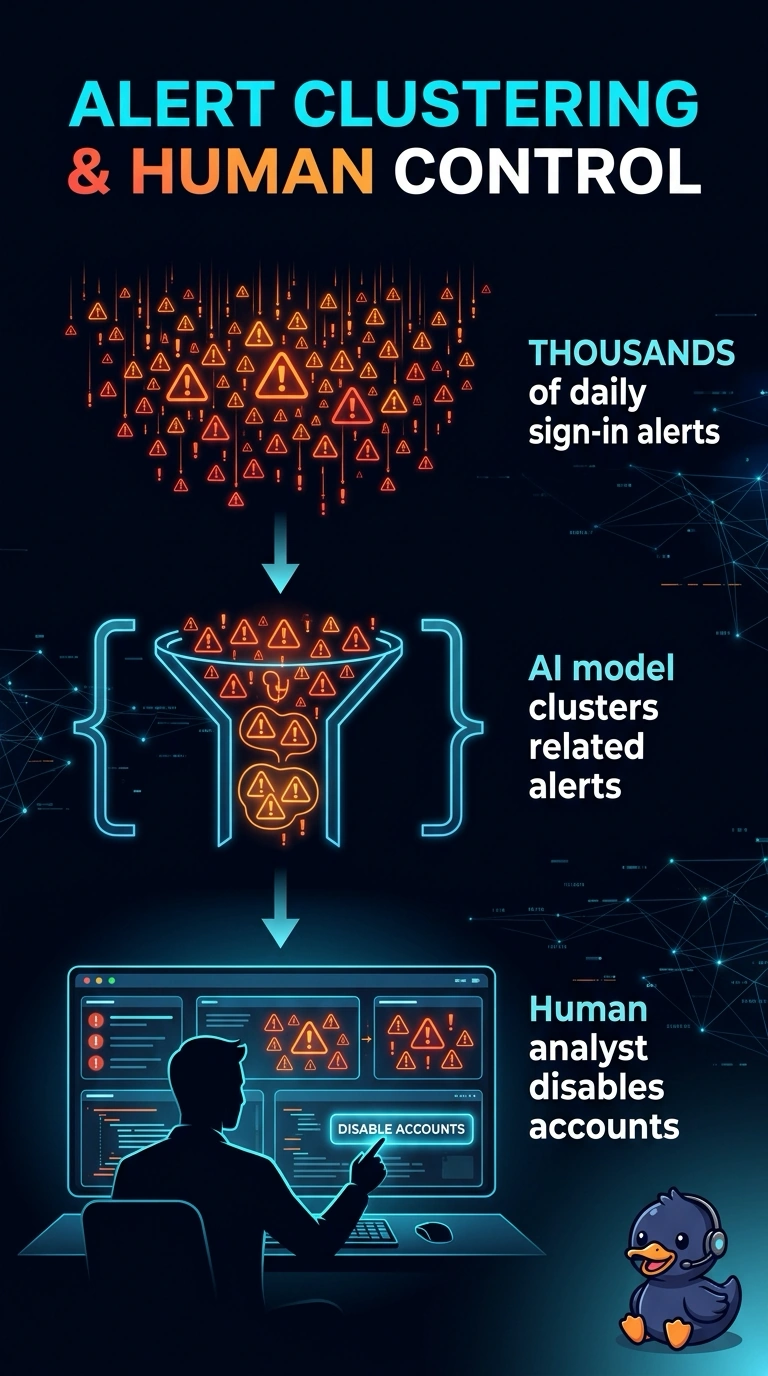
A bank's identity team receives thousands of odd-sign-in alerts a day. Leadership will allow a model to group related alerts, and it will not allow a model to disable an employee account on its own. Which design uses AI within that limit?
Select an answer to reveal the explanation.
Short Explanation
Think of the model as a clerk who stacks related files, not as the officer who locks the vault. You let it cluster sign-in alerts and you leave the disable action with an analyst. Auto-disable, a self-editing VPN list, or a stale monthly report breaks the limit you were given.
Full Explanation
The useful role of the model is triage: group alerts that share a user, a source, or a pattern so an analyst opens one case instead of hundreds. The authorization to disable an account stays with the analyst because that action locks an employee out of production systems. Clustering reduces the queue without moving the decision. A model that clusters related sign-in alerts for an analyst who disables accounts is the design that meets this requirement. A model that disables any account whose sign-in score crosses an unreviewed threshold is the wrong fit because disabling accounts is the action leadership refused to hand to the model. A model that rewrites VPN access lists whenever a new alert arrives is the wrong fit because changing VPN access lists is a second unauthorized action, not clustering. A static report of last month's logins with no grouping and no analyst queue is the wrong fit because a monthly report does not use the model to group the live alert stream the team cannot read. Exam caveat: A model that only clusters can still hide a rare attack inside a busy cluster, so the analyst queue needs a way to open a single alert that the model marked as low similarity. Operational check: During a pilot, compare a day's clustered queue with the raw alerts and confirm no disable action is available on the model's own service account.