
A biomedical institute allows one approved generative AI tool, but prompts that contain participant identifiers must be blocked. The tool and traffic are supported for AI Guardrails, and the participant identifiers match a built-in privacy identifier. Which control inspects those prompts?
Select an answer to reveal the explanation.
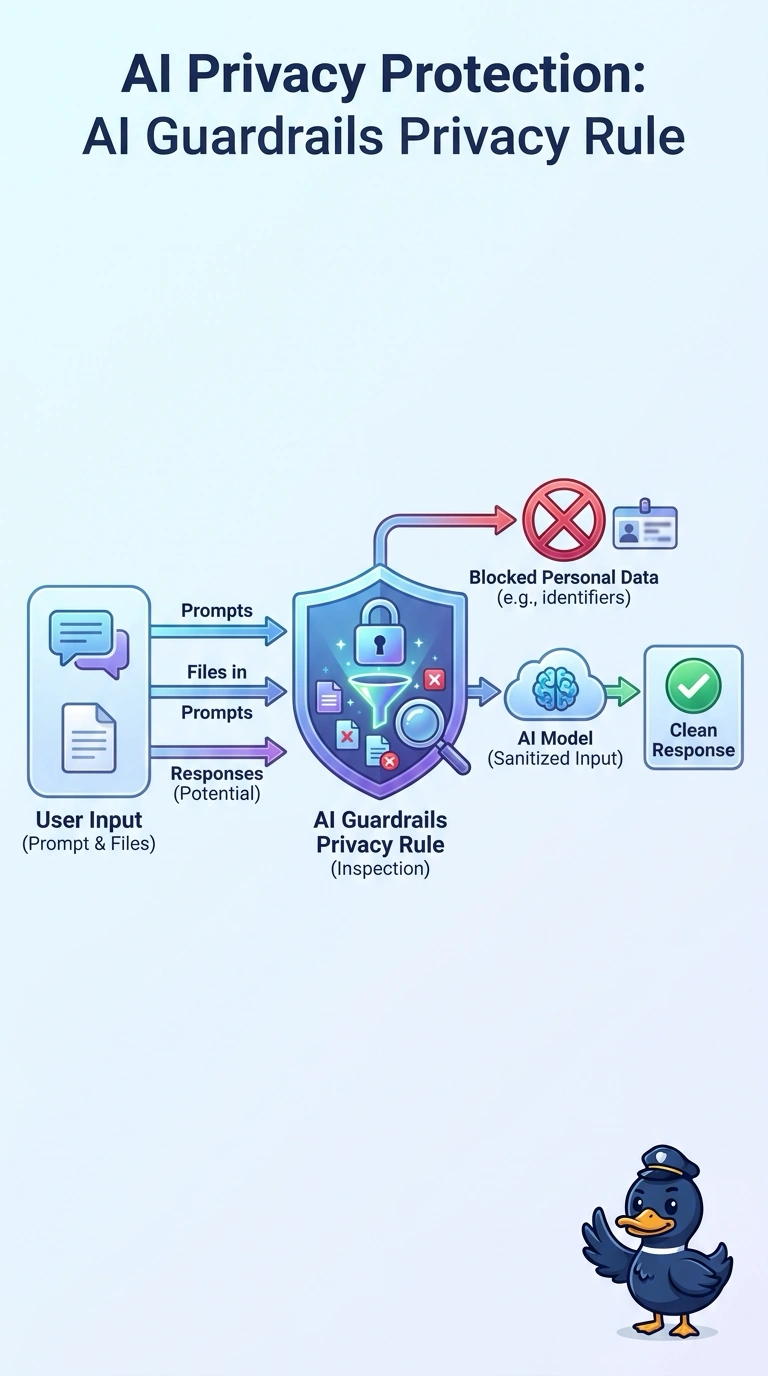
Short Explanation
Letting someone into the approved room does not mean you stop reading what they say once they are inside. You apply an AI Guardrails privacy rule, because that classification covers personal data in prompts and responses. A web address allow for the tool never opens the prompt text.
Full Explanation
The tool is allowed, and the remaining requirement is to block prompts that contain participant identifiers. Those identifiers are personal data, which is the privacy classification. An AI Guardrails privacy rule that inspects prompts, responses, and files in prompts for personal data such as participant identifiers is the control that reads the prompt. A URL allow that permits the approved generative tool for researchers and records only the destination that was opened never opens the prompt, so the identifiers pass inside an allowed session. A security-classification guardrail aimed only at prompt injection, with no privacy identifiers grouped into that classification, is built for prompt injection, which is the security classification, and it does not cover personal data when privacy identifiers are left out. A generic web upload rule, a different rule type, that treats the prompt text like any other file the browser sends is not an AI Guardrails rule. Exam caveat: you cannot create custom AI Guardrails data identifiers, but you can group the built-in privacy identifiers into a classification, and HTTPS inspection has to be on for an access rule covering the same identity or the prompt stays unreadable. Operational check: send a test prompt that contains a fake participant identifier and confirm the privacy rule blocks it, while a prompt without that data is allowed.