
A grocery chain finished fine-tuning its demand model this morning, and the last AI Defense validation ran before that fine-tune. What should the team do?
Select an answer to reveal the explanation.
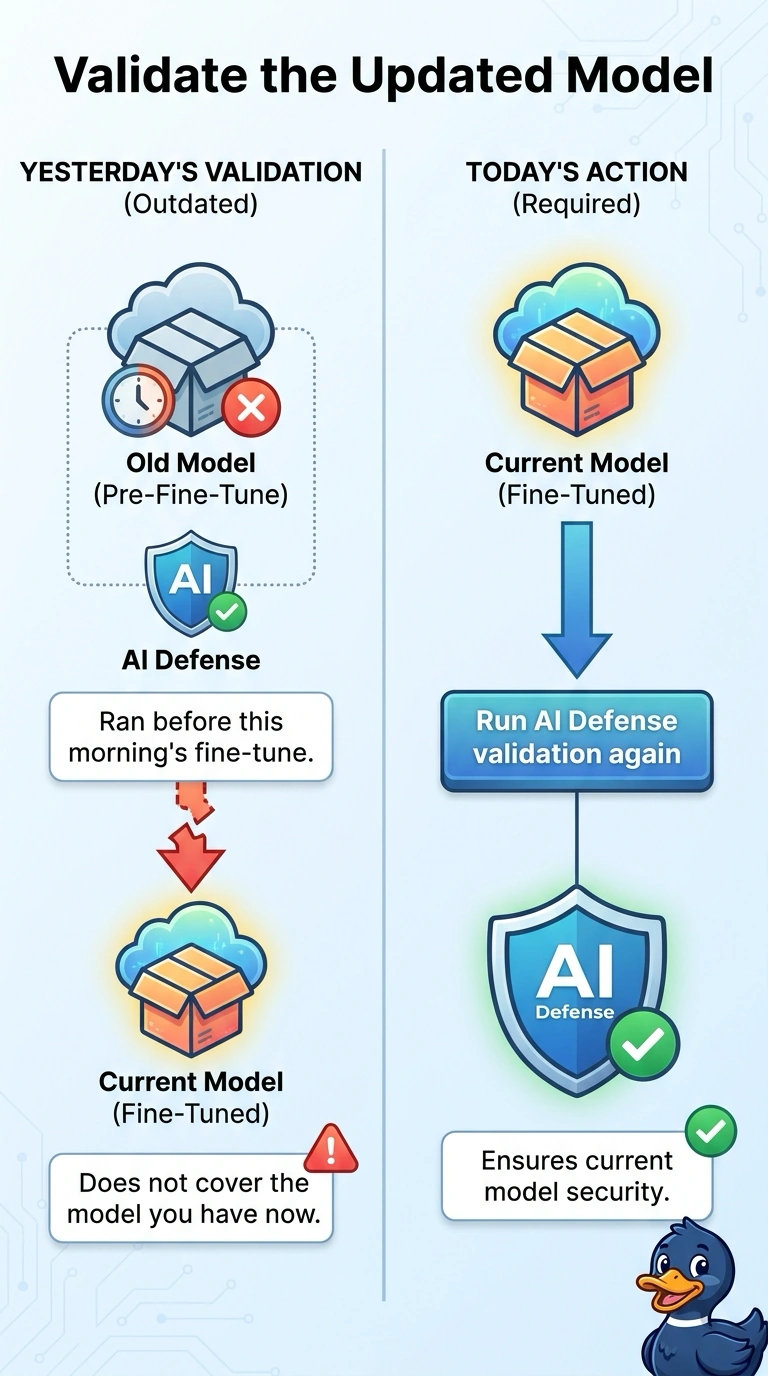
Short Explanation
You would not trust yesterday's inspection after the ingredients changed this morning. You run validation again, because a fine-tune produces a model the earlier result does not cover. Keeping the old report, or blocking a public website, leaves the new model untested.
Full Explanation
A fine-tune produces a different model. The last validation ran before that change, so it does not cover what is deployed now. The team should run AI Defense validation again, because the result from before this morning's fine-tune does not cover the model you have now. Re-validation after a fine-tune is the required step, not a courtesy. The choice to keep the pre-fine-tune validation in force, on the belief that a fine-tune changes speed and leaves the model's behavior untouched, treats a weight change as harmless, which is the assumption validation exists to challenge. The choice to block a public AI website from the grocery offices and record that block as the validation of this morning's model substitutes a web block for a test of the private model. The choice to turn runtime guardrails off until the next quarterly review and continue to cite the report from before the fine-tune removes a live control and keeps citing a stale result. Exam caveat: an earlier pass does not travel forward across a fine-tune, even when the application name stayed the same. Operational check: compare the validation timestamp with the fine-tune timestamp and do not mark the model current until a new validation covers the weights you just shipped.