
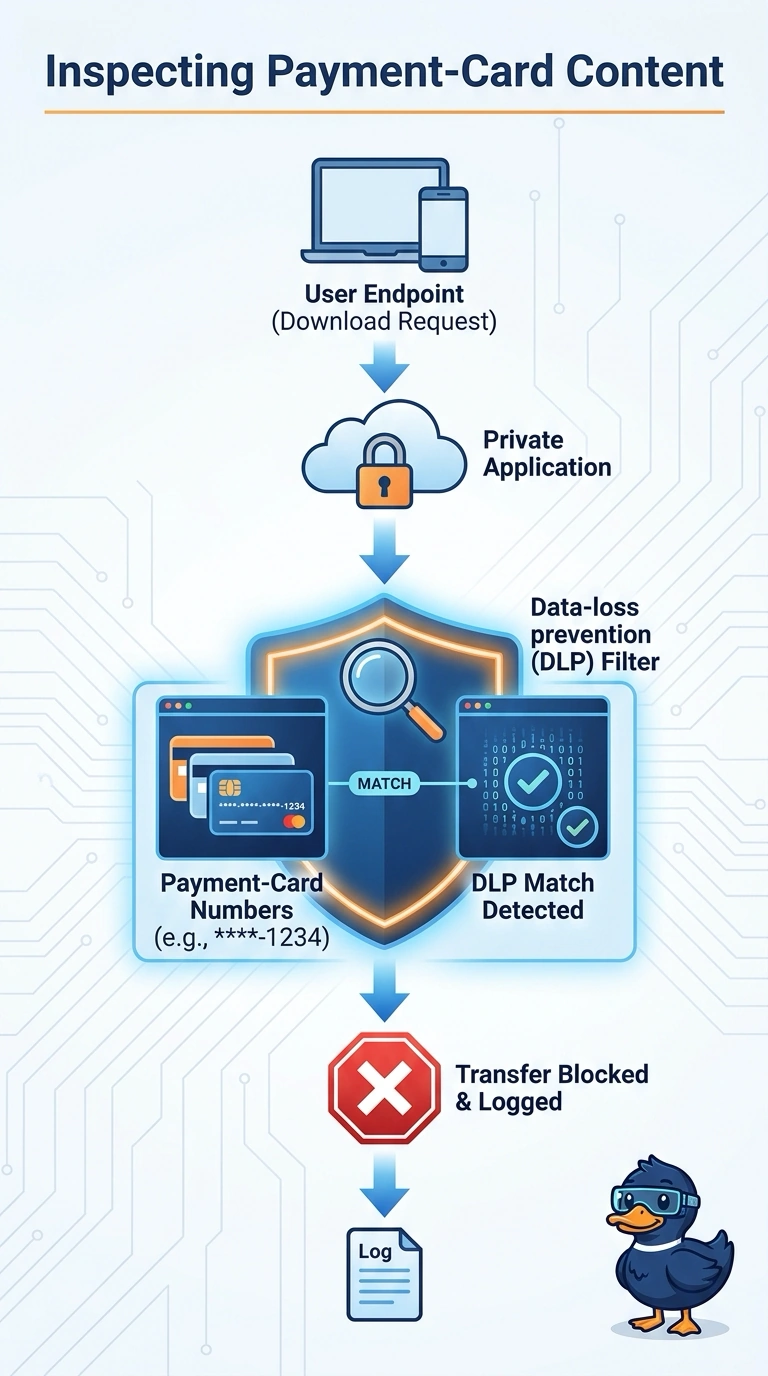
A factory user downloads a file from a private file application, and the file contains payment-card numbers. Which inspection matches that content?
Select an answer to reveal the explanation.
Short Explanation
Think of a guard who is watching for a forged signature, while you actually need someone who can read the account numbers on the page. You use data-loss prevention, because it matches the payment-card content in the download. The trap is asking intrusion prevention, or a DNS block, to recognize that pattern.
Full Explanation
Data-loss prevention matches sensitive content, and intrusion prevention looks for exploits. A download that contains payment-card numbers is a content match, so data-loss prevention is the inspection that matches the payment-card content in that private-application download. Intrusion prevention does not match payment-card numbers the same way it matches an exploit. Those are different patterns and different controls. A DNS block of the private application name does not read the card numbers inside the downloaded file, because DNS does not see a file body and a name block would not classify the content. The allow decision for the private file application is not a data-loss verdict. An allow means the user may reach the application, and it does not classify the file. Exam caveat: match the sensitive content, not every file of a broad type, and remember that an encrypted archive you cannot open cannot be classified. Operational check: download a test file that contains payment-card numbers from the private application and confirm data-loss prevention matches it while a file without that content is handled by the allow.