
Factory planners open a cloud scheduling application in the browser. A site-to-site IPsec overlay already links the plant to the data center. Which protection covers that browser session to the application?
Select an answer to reveal the explanation.
Short Explanation
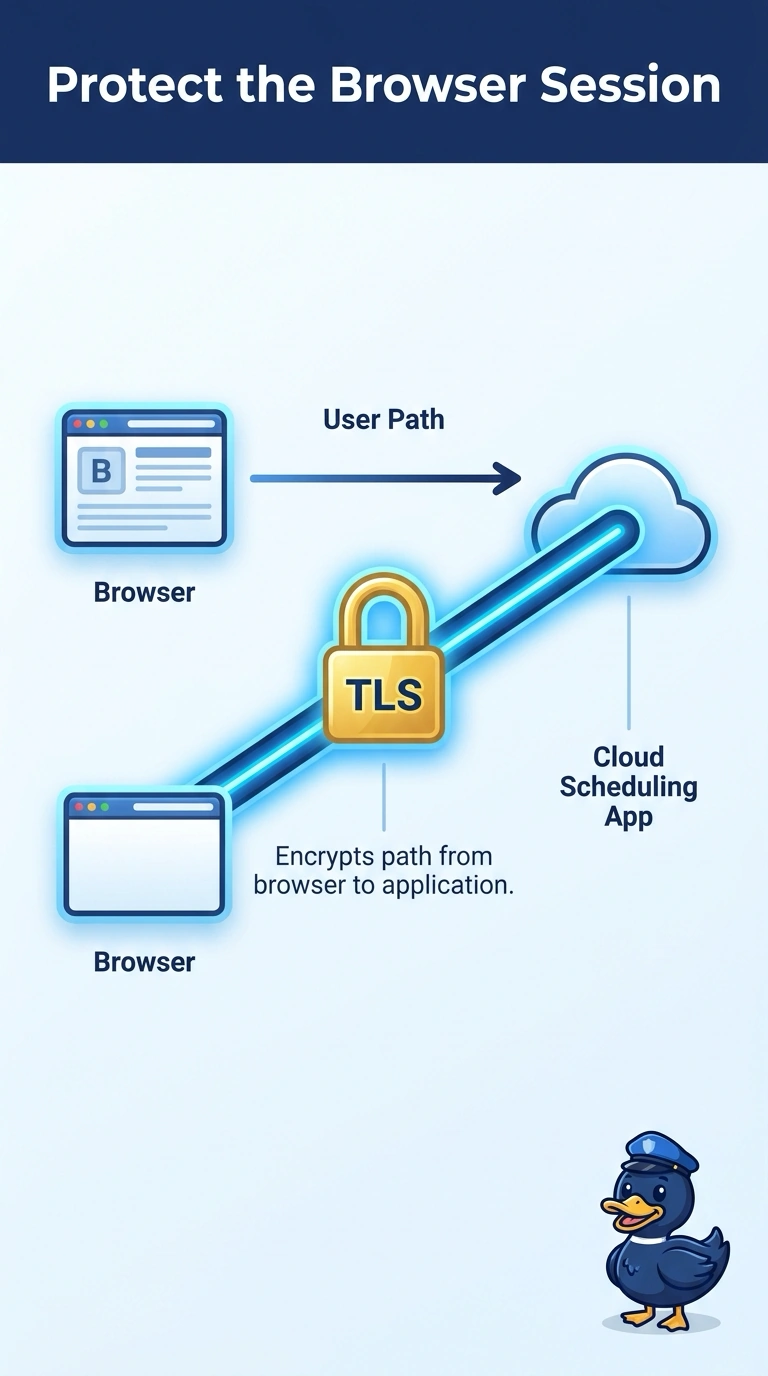
Think of a locked truck that runs between two plants while the letter you mail still needs its own envelope. You protect this browser session with TLS to the scheduling application, because that is the path the planners are on. The trap is assuming the plant-to-data-center tunnel, or disk encryption, stands in for that session.
Full Explanation
Users reaching a SaaS application in the browser are on an application session, and TLS to that application is what protects the session on the wire. The site-to-site IPsec overlay between the plant and the data center is a different path, and it does not replace TLS for this SaaS session. Encryption at rest on the scheduling vendor disks protects stored bytes, and it does not hide the live browser session from someone who can watch the download. A private IPsec tunnel that ends at a concentrator leaves the next hop unprotected, and assuming it covers the SaaS hop after it confuses a network tunnel with the application session. TLS on the browser session to the scheduling application is the path the planners actually use, so that is the protection that matches the visit. Exam caveat: IPsec protects a tunnel, and TLS protects an application session. They answer different hops. Operational check: confirm the browser session to the scheduling application negotiates TLS, and do not mark the session covered only because the plant overlay is up.