
One planner at a logistics hub sends far more data to a personal storage application than that user's baseline shows. What should the investigation use?
Select an answer to reveal the explanation.
Short Explanation
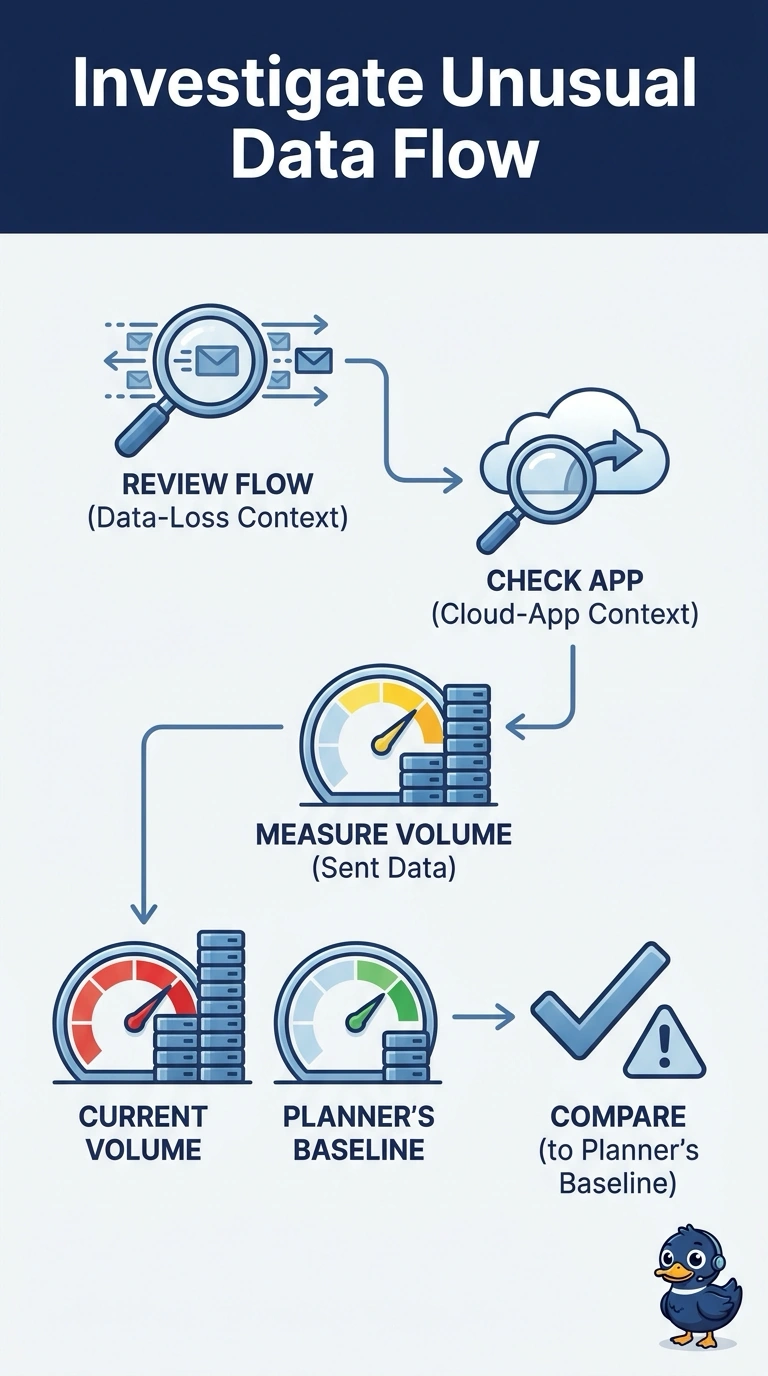
A scale that shows one person shipping a huge box tells you more than a thermometer on the wall. You investigate with data-loss or cloud-application context and compare the volume with that user's baseline. A processor alarm does not explain which destination received the data.
Full Explanation
The anomaly is volume to a destination, compared with one user's baseline. You investigate with data-loss or cloud-application context and compare that volume with the planner's own established baseline, because that context names the personal storage application and the person. The choice to open a CPU alarm on the planner's workstation and end the review once the processor graph has been collected stops on a processor signal that does not explain the destination. The choice to raise the transfer threshold until the personal-storage volume no longer differs from the baseline already recorded for that same user hides the deviation, and raising a threshold to quiet a new pattern hides the incident. The choice to treat the volume spike as carrier packet loss and open a circuit ticket so the provider can look at the path confuses a transfer above baseline with packet loss, and those are different signals. Exam caveat: a new autoscaled address can be benign when identity is stable, but a stable user sending far more data to personal storage is not that case. Operational check: pivot from the volume anomaly to the data-loss or cloud-application log for that planner and that destination, and do not close the case on a processor graph.