
An airline is ready to ship a crew-scheduling model that its own team fine-tuned. Which tool validates that model before it ships?
Select an answer to reveal the explanation.
Short Explanation
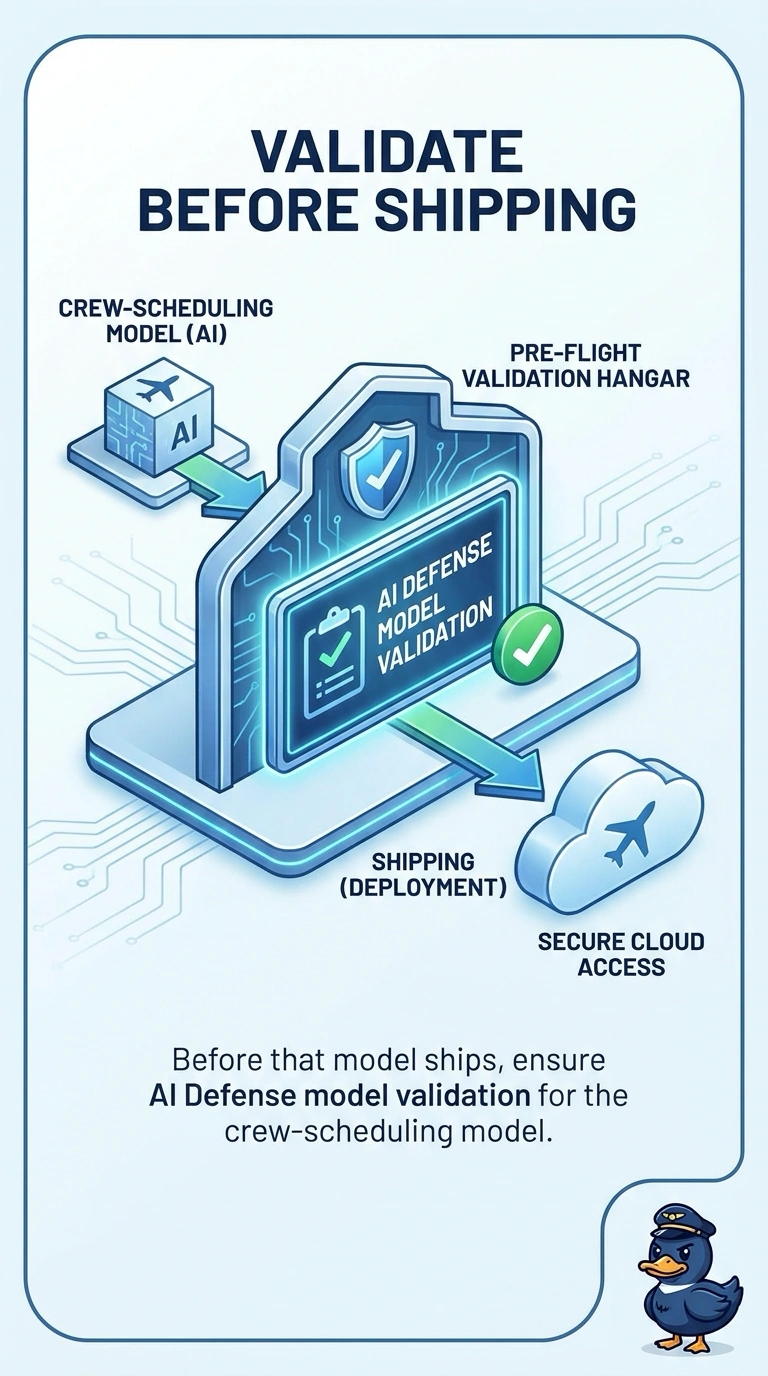
You’re right to validate the crew-scheduling model your team fine-tuned before it ships. AI Defense model validation checks that model itself; a DNS blocklist of public chatbot names only stops those lookups.
Full Explanation
AI Defense is the product for validating models your enterprise builds or fine-tunes, and it is also where runtime guardrails for those applications belong. AI Defense model validation checks the crew-scheduling model the airline built or fine-tuned before it ships, so it directly addresses the need. A DNS blocklist of public chatbot names stops those lookups; it does not test the crew-scheduling model itself, so blocking a public name is not model validation. AI Access in Cisco Secure Access discovers employee use of third-party generative AI, but it does not validate a model the airline ships. AI Guardrails on prompts and responses classify content in an approved tool rather than validate the model itself. Their built-in classifications cover security, safety, and privacy of prompt content, a different control from testing the model that is about to ship. Exam caveat: re-validate after a further fine-tune, because a prior pass does not cover the new model. Practical check: record an AI Defense validation result for this crew-scheduling model; do not accept a DNS blocklist or an AI Access report as that result.