
A hospital platform team must enforce pod-identity network policy and see east-west flow visibility inside a Kubernetes cluster. Which tool matches that job?
Select an answer to reveal the explanation.
Short Explanation
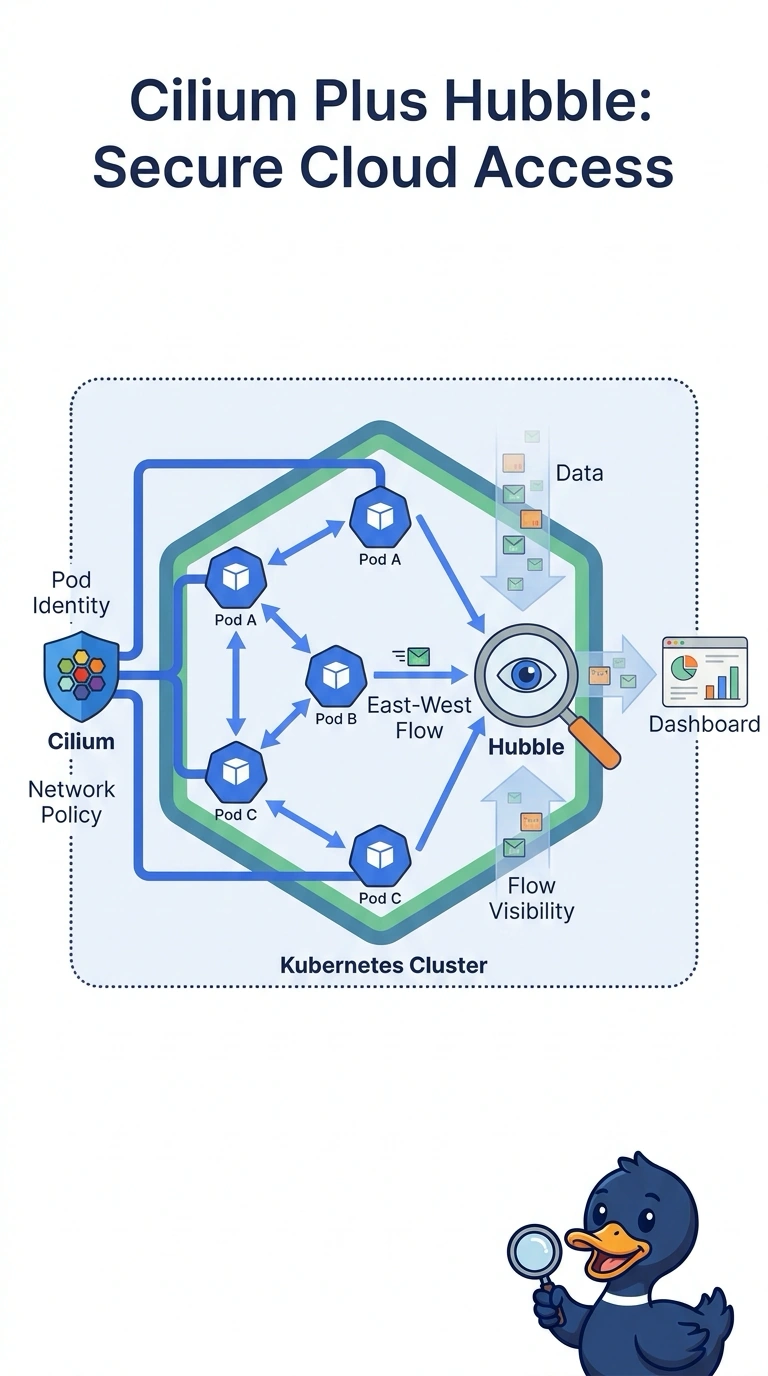
Think of a traffic cop for the hallways between rooms, which is a different job from checking a badge at the front door. You pick Cilium for pod identity and network policy, with Hubble enabled for flow visibility. The trap is assigning that hallway job to a sign-in product, a process sensor, or a user web gateway.
Full Explanation
Cilium provides pod identity and network policy enforcement, and Hubble, its observability layer, shows the flows when enabled. That is the match for enforcing which pods may talk and for seeing those east-west flows. Duo is a user sign-in product, and a user sign-in prompt is not what enforces which pods may talk to each other on the cluster. Tetragon is the runtime sensor for process, system call, and file activity, and a runtime process sensor is not the same control as pod-identity network policy. A secure web gateway applies category and URL policy to user web traffic, and user web categories do not govern traffic between pods on the same node. Flow visibility in this job means showing which pod identity talked to which other pod identity, and Hubble provides that record for the same Cilium data plane that enforces the network policy. Exam caveat: Cilium and Tetragon are both cluster sensors, and they do not swap jobs. One watches pod network identity, and the other watches process behavior. Operational check: confirm the hospital cluster policy names the consumer pod, the provider pod, and the allowed flow, and that the associated flows appear in Hubble.