
A clinic employee consents to a malicious OAuth application that asks for broad mail scopes inside the sanctioned mail tenant. Which mitigation matches that software-as-a-service abuse?
Select an answer to reveal the explanation.
Short Explanation
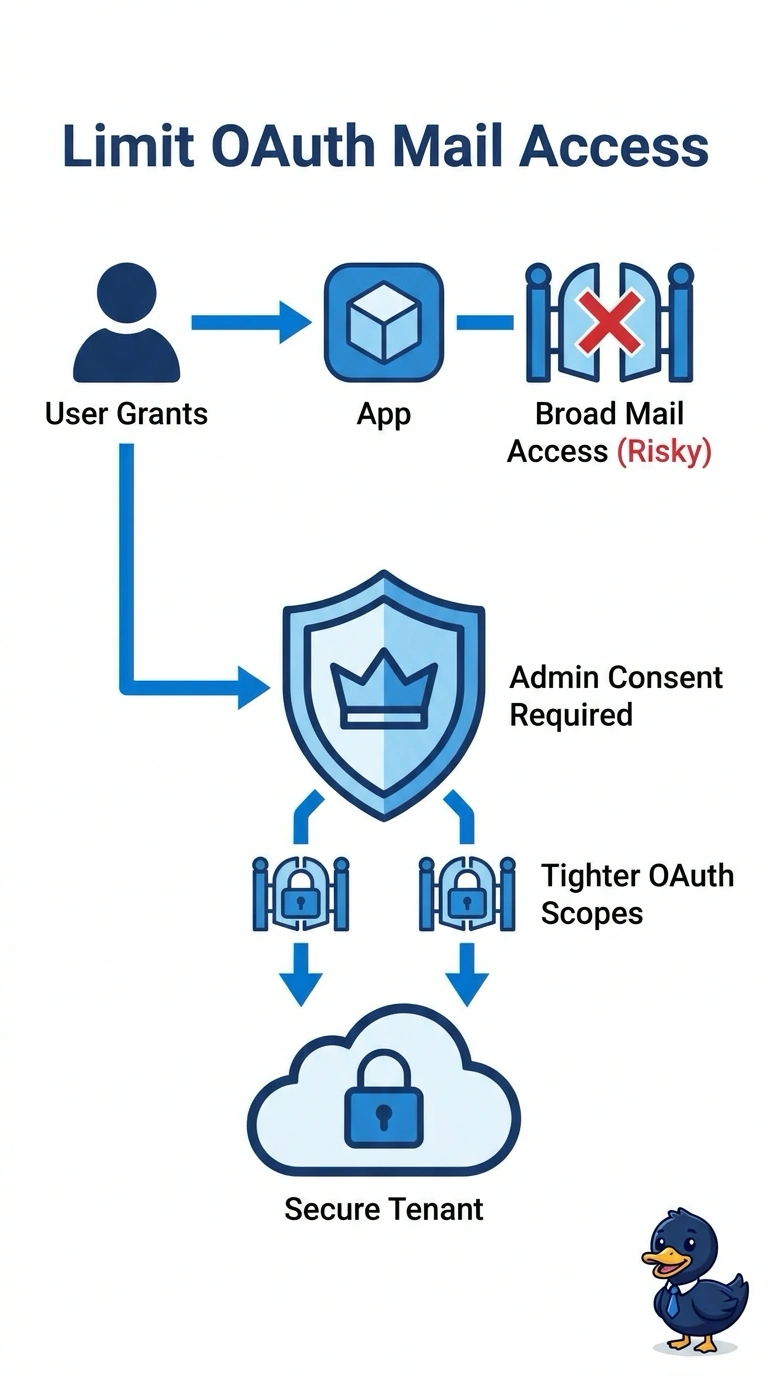
Giving a stranger your mailbox key because they asked nicely at the desk is how private mail gets read. You require administrator consent and tighter scopes so one person cannot grant broad mail access. The trap is blocking the real vendor domain in DNS, which punishes the legitimate tenant.
Full Explanation
This is software-as-a-service abuse through an OAuth grant, not a failure of name resolution. Requiring administrator consent and tighter OAuth scopes stops one employee from granting a malicious application broad mail access in the sanctioned tenant. Blocking the real mail vendor domain in DNS makes the legitimate tenant unreachable and does not remove a grant against that vendor's real application. A host firewall on the clinic workstation filters local traffic and leaves the broad mail consent in place inside the tenant. Replacing the SAML signing certificate rotates the single sign-on signing key and does not revoke an OAuth grant, just as rotating that certificate does not kill a separate provisioning token. Exam caveat: identity-provider token forgery is a different surface from a user consenting to an application, and the matching control has to follow the consent path. Operational check: review the tenant's granted applications, confirm user consent is disabled for broad mail scopes, and revoke the malicious grant that was already accepted.