
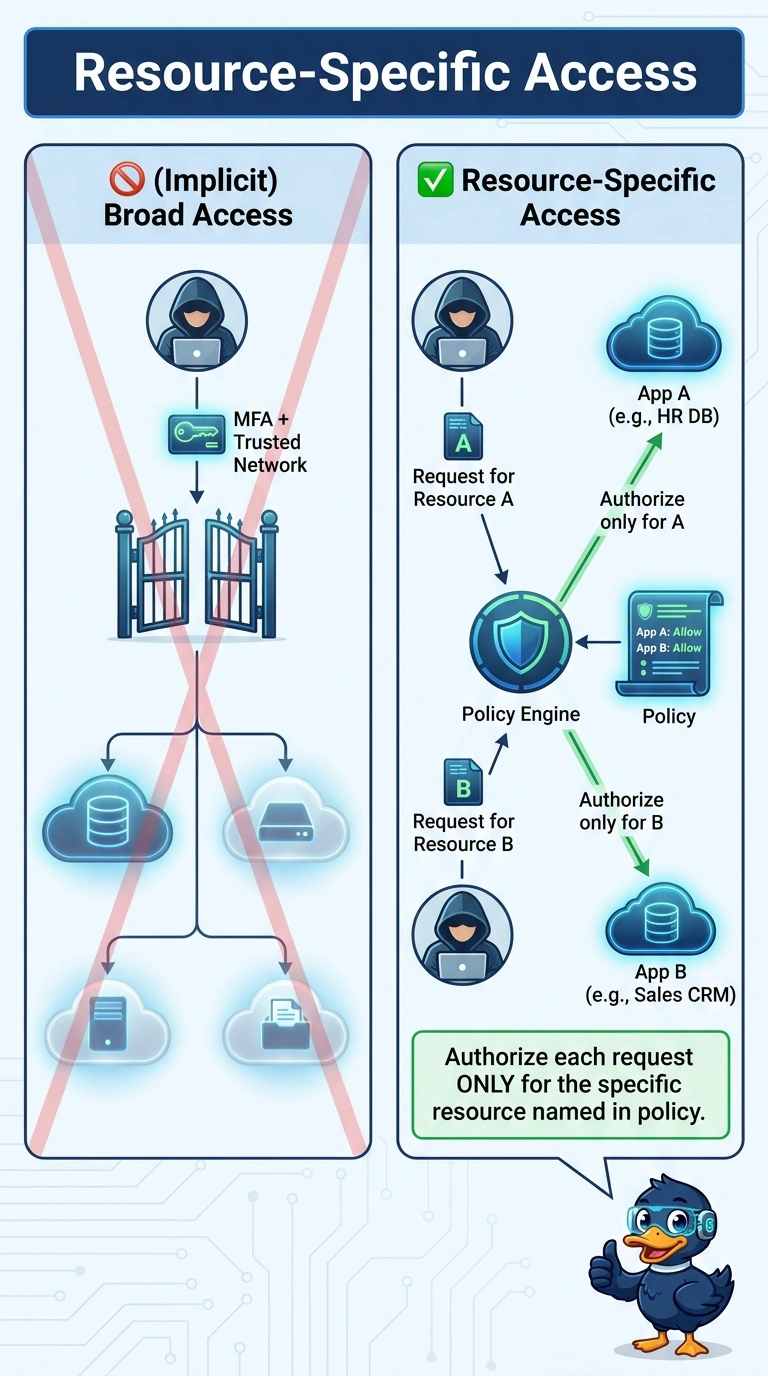
A bank gives staff one MFA prompt, places them on a trusted VLAN, and then lets that VLAN reach every internal application. Which change aligns the design with zero trust for a specific resource?
Select an answer to reveal the explanation.
Short Explanation
Clearing the lobby once is not a key to every office on the floor. After one MFA prompt, a trusted VLAN that can reach every internal application is still trust of a whole segment. You authorize the specific resource on each request instead.
Full Explanation
Zero trust grants a specific resource on a specific request. It does not grant the inside of a VLAN after one authentication and then stop checking. Authorizing each request only for the specific resource named in policy is the change that drops segment-wide trust, instead of treating one MFA prompt plus a trusted VLAN as access to every internal application. Keeping the single MFA prompt at the VLAN boundary and then allowing every internal banking application preserves the design under review. Adding another firewall between the staff VLANs while still trusting every user who already passed that single MFA prompt adds a box and keeps the one-time pass. Enlarging the trusted VLAN so the same one-time prompt covers a wider set of internal banking applications expands implicit trust rather than shrinking it. On the exam, a trusted segment after a single prompt is the opposite of per-resource authorization, even when MFA sits at the edge. In operations, pick one internal banking application and confirm a user on that VLAN is authorized per request for that application, not admitted to the whole segment for the rest of the day.