
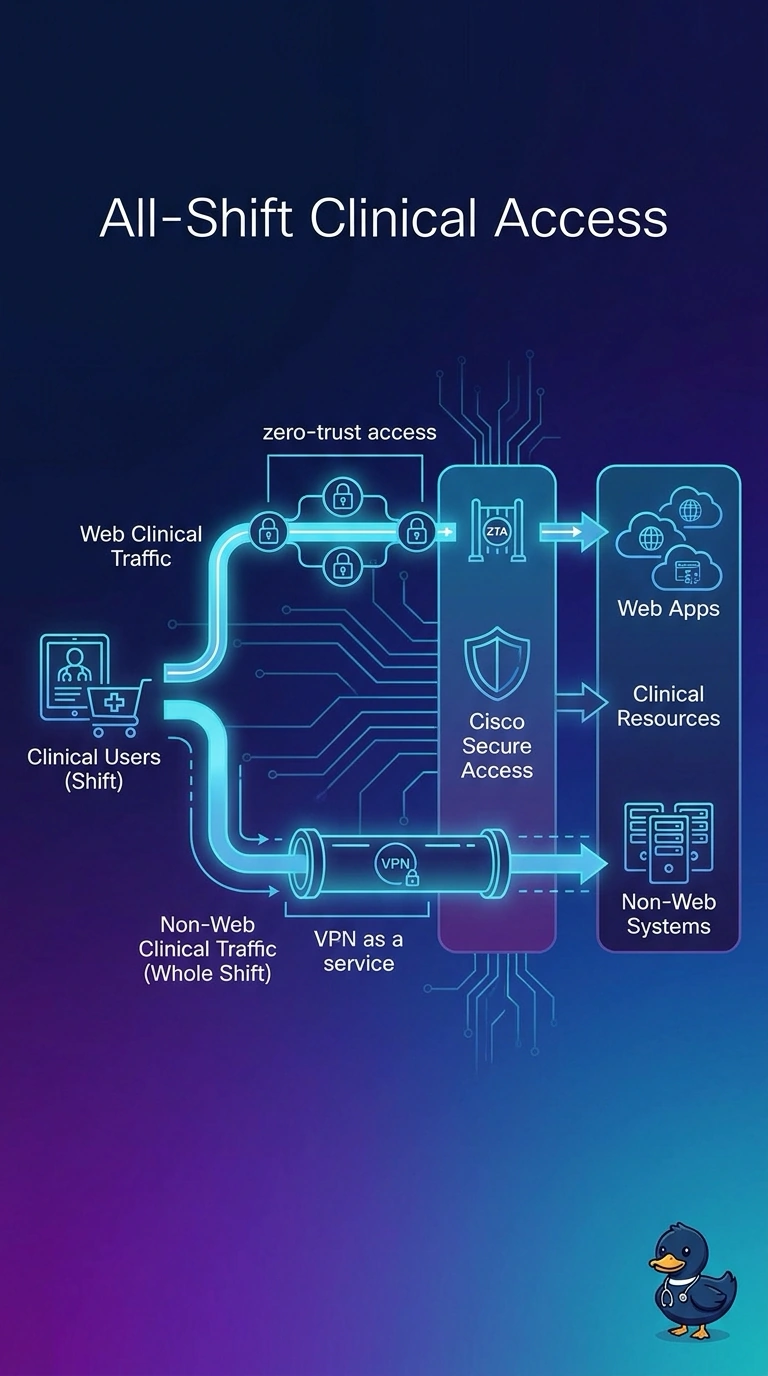
Clinicians at a children's hospital carry managed laptops that must send non-web clinical traffic into Cisco Secure Access for the entire shift, including protocols that zero-trust access cannot carry. Which access method provides that coverage?
Select an answer to reveal the explanation.
Short Explanation
A bus pass gets you on the bus, and a coffee-shop bookmark does not drive the truck. Non-web traffic that zero-trust access cannot carry needs VPN as a service for the whole shift, because a browser path never carries those protocols. The trap is treating a saved portal page as if it were a full private tunnel.
Full Explanation
VPN as a service is the full private-access method for non-web traffic that zero-trust access cannot carry, and these laptops must send that clinical traffic into Secure Access for the whole shift. A browser session does not become a general network transport. A saved browser bookmark to the clientless portal opens a web path to a published page. It does not make the laptop send every non-web protocol through that page. A DNS blocklist on the hospital resolver can stop a name lookup for a blocked destination. It does not steer clinical protocols into the security service edge, and a client that already has an address does not consult that list. A ThousandEyes path test measures experience along a path. A green path result does not authorize traffic, and it does not open a non-web session into Secure Access. Exam caveat: a successful login to a saved portal page only shows that a web path works, which is not evidence that non-web clinical traffic is covered. Operational check: from a managed laptop, confirm a non-web clinical connection enters through VPN as a service and that a machine without that session cannot open the same protocol.