
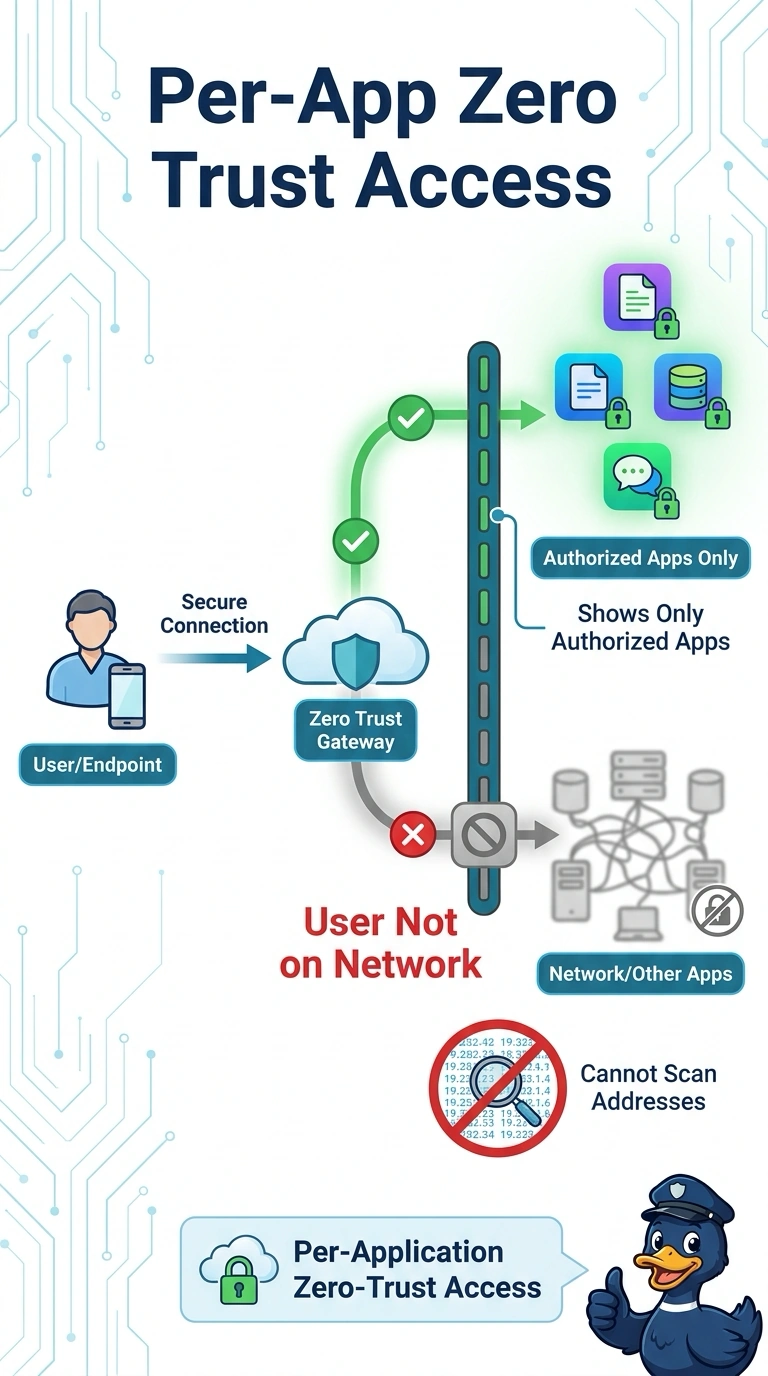
A hotel requires that staff open only the applications they are allowed to use and that they cannot scan neighboring addresses on the server network. Which access method fits that requirement?
Select an answer to reveal the explanation.
Short Explanation
Handing someone a map of the whole floor lets them try every door, even when you meant one room. You use per-application access so the user never sits on the server network where neighbors can be scanned. The trap is routing the whole segment and calling that the same control.
Full Explanation
Per-application zero-trust access grants the named applications and does not place the user on the server network, so neighboring addresses are not presented as a routed segment the client can scan. That is the method that fits the hotel requirement. A subnet VPN that routes the whole server segment onto the client does the opposite. It exposes neighboring addresses so staff can scan that segment, which fails the requirement even if the user was only supposed to open one application. DNS security by itself blocks or allows names at a resolver. It does not hide private addresses from a client that already has a route, and a scan of neighboring hosts can use addresses without a name lookup. A TLS inspection bypass for the hotel category leaves some web sessions uninspected. It does not remove neighboring routes from the user device, and inspection policy is not what hides a subnet. Exam caveat: client-based and clientless zero-trust access are per application, while a subnet VPN places the user on the network. Operational check: from a test client using the chosen method, confirm only the authorized application opens and that a probe of a neighboring address is not routed.