
A factory must let contractors reach one private web application in a cloud network without extending that whole subnet to them. Which design matches the limit?
Select an answer to reveal the explanation.
Short Explanation
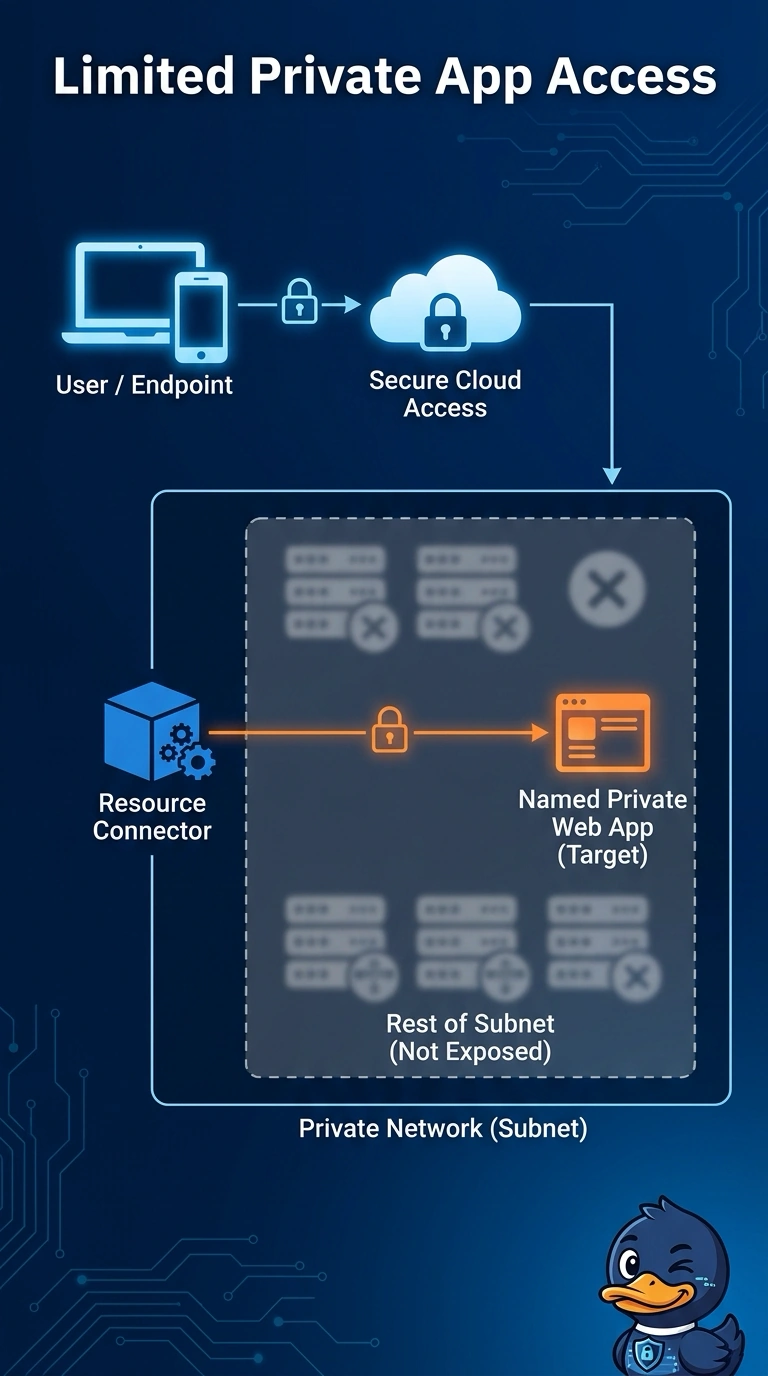
You hand someone a key to one labeled door, not a badge for the whole plant. You place a resource connector beside the application and expose only that named private web application over its outbound connection. The trap is tunneling the entire subnet, or dragging in an address range that connector designs do not need inside your network.
Full Explanation
A resource connector is a virtual machine in the network that makes outbound connections only and exposes the private resources you name. Placing one in that network and exposing only the one named private web application reaches the app without extending the whole subnet. An IPsec tunnel for the entire subnet makes every host on that cloud network reachable, which is more access than the factory requested. Routing the carrier-grade range 100.64.0.0/10 inside the factory network is a static-routing item for IPsec private access, and a connector design does not require that range on the customer network. A full remote-access VPN places the user on the cloud subnet for every protocol, which again extends far more than the one web application. Exam caveat: when a connector group and a network tunnel both serve the same resource and the group is reachable, the connector is the preferred path. Operational check: from a contractor account, open the named application and confirm other addresses on that subnet are not reachable through the connector.