
A laboratory instrument is reached by a thick client that speaks a custom protocol other than HTTP or HTTPS. What should carry this traffic instead of the secure web gateway?
Select an answer to reveal the explanation.
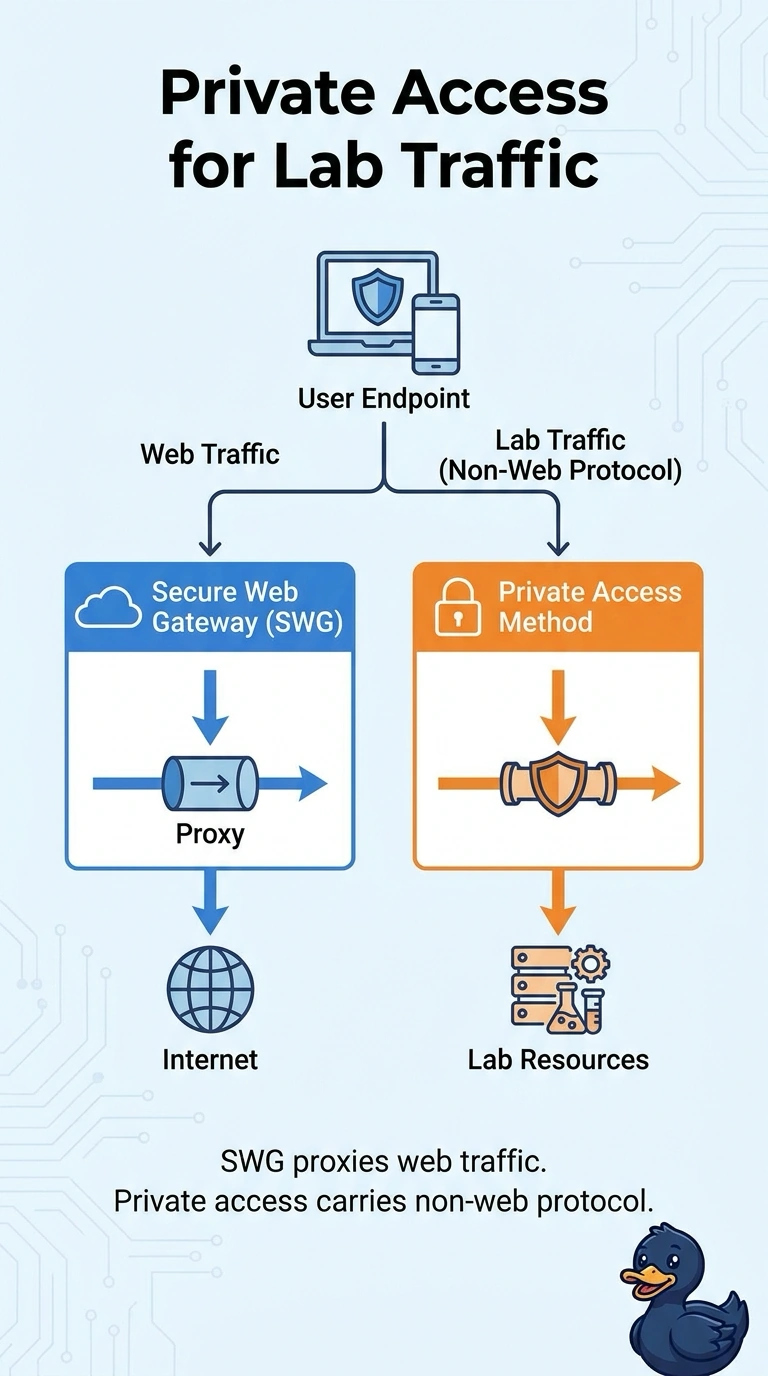
Short Explanation
Think of the secure web gateway as a toll booth for web traffic, not a ferry for every protocol. You need a private-access method that can carry the thick client’s custom non-web protocol; pointing the client at the web proxy does not change that protocol.
Full Explanation
The secure web gateway proxies web traffic, so use a private-access method that can carry the laboratory instrument’s custom non-web protocol. Sending the thick client through the gateway on the claim that an explicit proxy can carry any protocol it speaks does not work: pointing the client at a proxy does not make the proxy a general transport. Blocking the instrument name in DNS is a coarse name control, not an access method or a path that carries the application’s traffic. Enabling TLS inspection also fails to solve the problem: decryption does not rewrite a custom non-web protocol into an ordinary HTTP request. The private-access method is the right choice because it can carry the protocol the thick client actually uses, rather than expecting the web gateway to carry it. Exam caveat: clientless zero-trust access is still for browser-based HTTP and HTTPS, so the private-access method must specifically support this non-web protocol. Practical check: identify the protocol spoken by the thick client, confirm the chosen private-access method can carry it, and verify that communication does not depend on the secure web gateway.