
A change-control audit requires proof of the exact CLI commands two administrators ran on a core switch last Friday, and the team also wants to review failed login attempts from a contractor account. The switch already uses TACACS+ for authentication and authorization. Which ISE logging setup should the engineer enable?
Select an answer to reveal the explanation.
Short Explanation
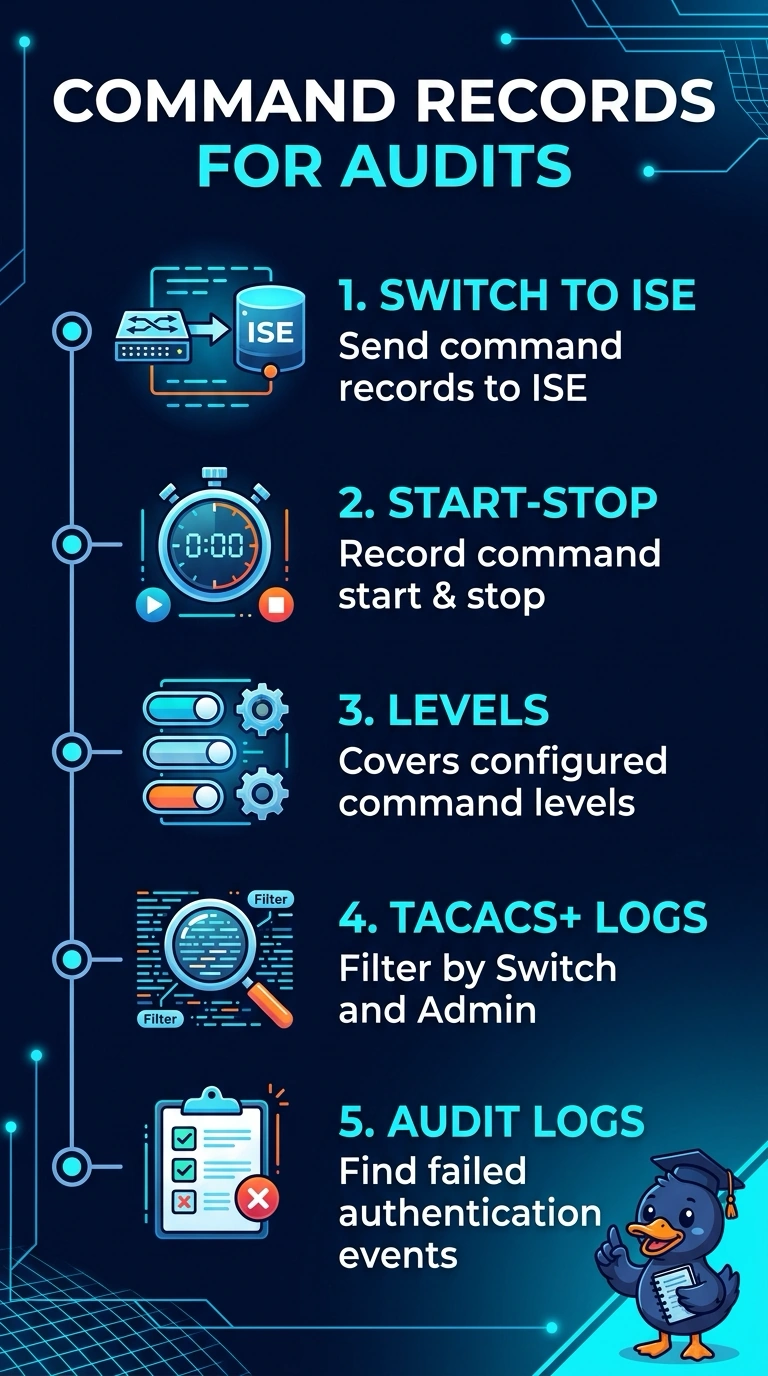
Authorization controls what you’re allowed to run, while command accounting keeps a record of what you actually ran. Configure the switch to send start-stop records to ISE, then review the TACACS+ logs for command history and failed contractor login attempts.
Full Explanation
TACACS+ command accounting records the commands administrators actually issue, so configuring the switch to send start-stop accounting records to ISE provides an audit trail of exact CLI activity. Reviewing the TACACS+ logs also lets the team examine authentication events, including failed contractor logins. Stop-only command accounting is a valid method for recording command activity, but relying on those accounting records does not reliably provide evidence of failed logins: failed authentication attempts are authentication events, not completed command-accounting records. TACACS+ command authorization and authentication-failure logging can show whether a requested command was permitted and document failed logins, but authorization records do not prove the command was subsequently executed. TACACS+ exec-session accounting and authentication-failure logging can document administrator sessions and failed logins, but session-level records do not capture each CLI command and therefore cannot establish the exact commands entered. Exam caveat: authorization, authentication, session accounting, and command accounting answer different audit questions; evidence that a command was allowed or that a session existed is not evidence that the command ran. Practical check: after enabling accounting, run a harmless test command and confirm ISE receives a command-level record with the expected administrator identity, command text, and timestamp, then verify a controlled failed login appears in the relevant TACACS+ authentication logs.