
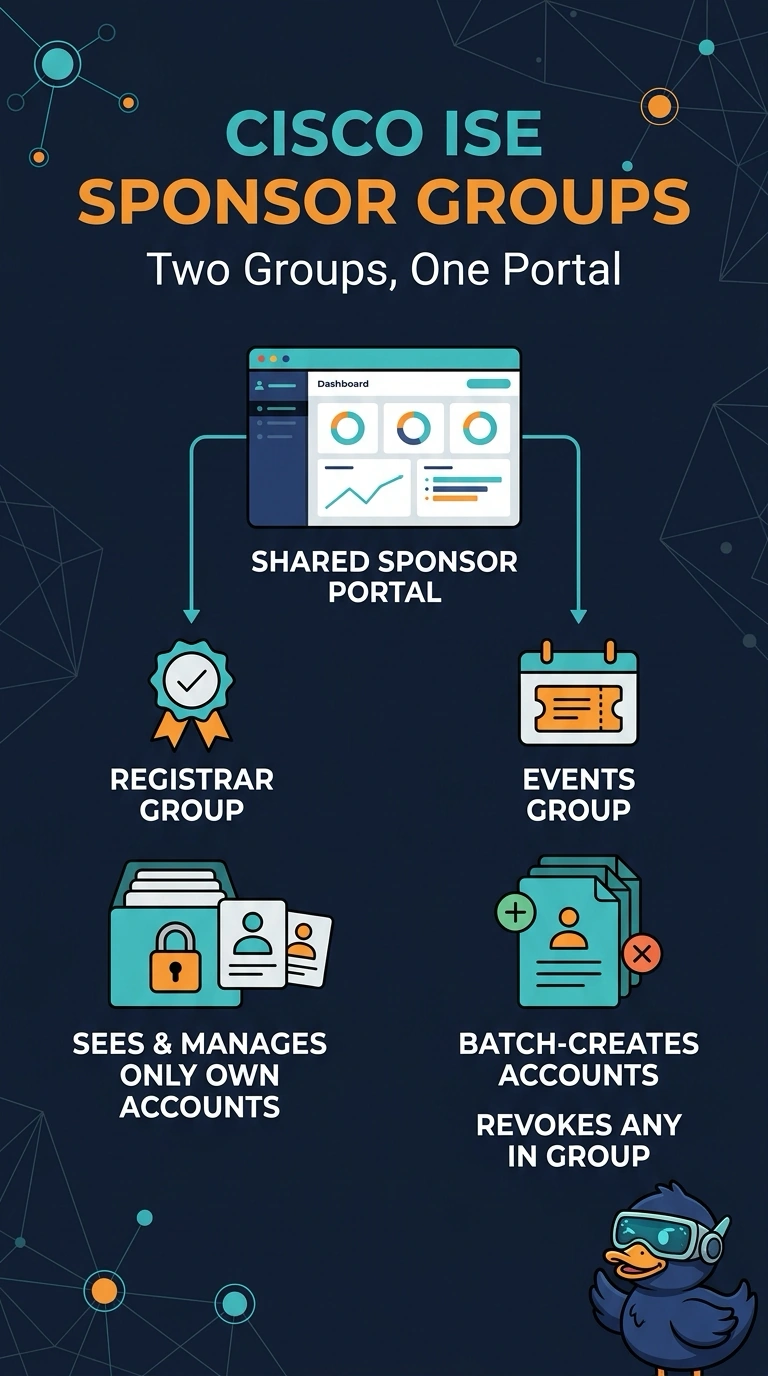
A university runs one ISE guest portal for visiting lecturers. The registrar's office creates and extends accounts only for its own visitors, while the events team must issue bulk accounts for conferences and revoke any guest account belonging to its department. Both teams share the same portal page. Which sponsor group configuration meets both teams' permissions?
Select an answer to reveal the explanation.
Short Explanation
Nice one to reason through: you'd split the two teams into separate sponsor groups so each gets exactly the rights it needs. The registrar stays scoped to its own accounts, while events gets batch creation and revocation within its permitted scope. It's like two keys at the same help desk window, where one only opens its own drawer.
Full Explanation
In ISE, sponsor group settings define sponsors' guest-account permissions and scope, while the sponsor portal also has its own configuration. The registrar's team needs the narrow scope: manage only accounts its own sponsors created, while the events team needs batch account creation for conferences plus the ability to revoke accounts belonging to its department, so two groups with different permission sets satisfy both. A single sponsor group granting batch creation and broad revocation to everyone hands the registrar's staff power they were explicitly denied, which breaks the separation the scenario requires. Two groups where only administrators may revoke fail the events team's requirement to revoke accounts belonging to its department, so that team would depend on someone else for a task it must perform itself. A narrow group paired with portal self-registration keeps the registrar safe but moves issuance onto the visitors themselves, so the events team does not get sponsor-managed bulk accounts for a conference. One exam caveat: sponsor rights appear as configurable permissions, and wording can vary between releases, so reason from the capability rather than from memory. A practical check: log in with a test sponsor from each team and confirm which accounts and actions actually appear.