
A university profiles thousands of BYOD laptops, and many match one broad condition that labels them as Cisco IP phones with a low certainty factor, feeding them into the wrong authorization rule. Which profiler policy control should be used so weak evidence leaves endpoints Unknown?
Select an answer to reveal the explanation.
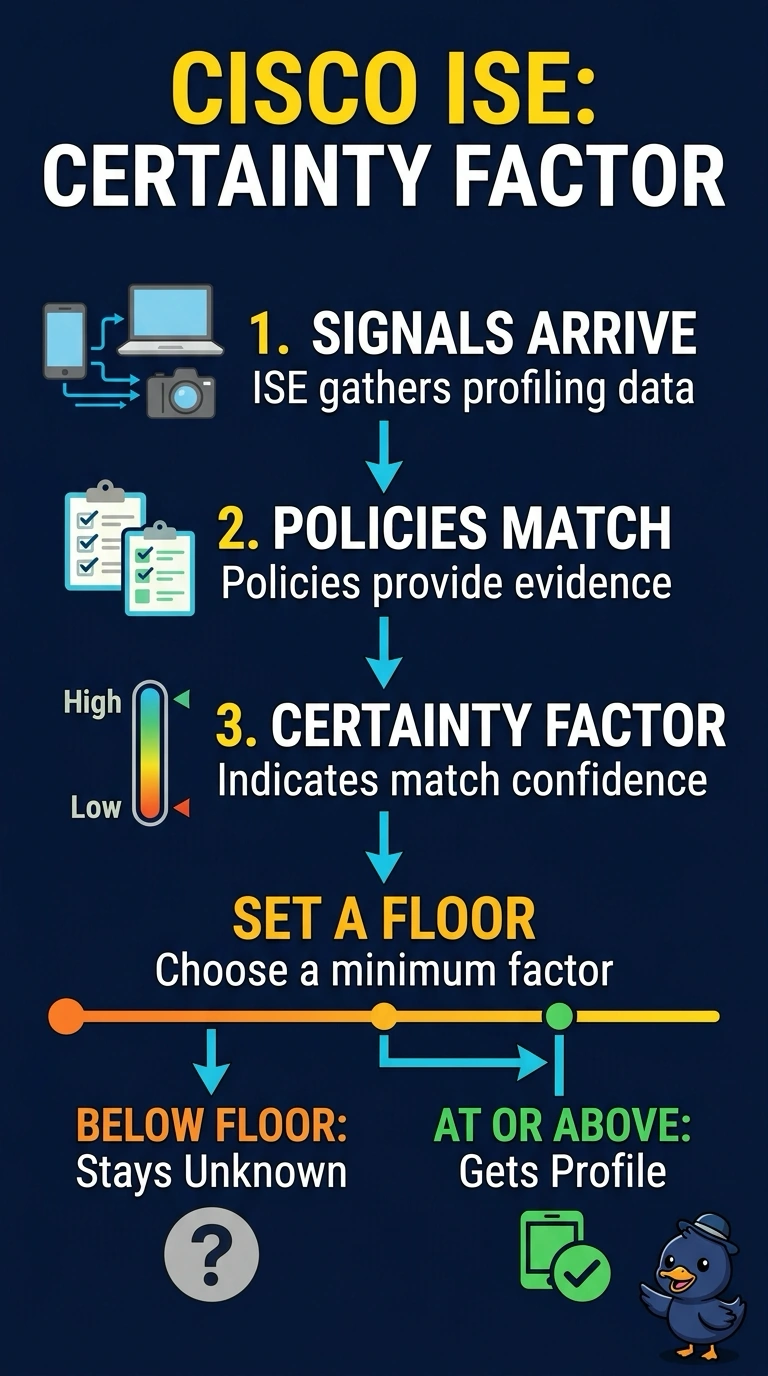
Short Explanation
The certainty factor shows how confident a profile match is—like a confidence bar for each device. Raise the minimum certainty factor so weak matches stay Unknown instead of sending your laptops to the wrong authorization rule.
Full Explanation
Raising the minimum certainty factor is the direct control for this failure mode: a profile can be assigned only when the accumulated evidence meets the configured confidence floor, so weak matches remain Unknown instead of triggering the phone authorization rule. Refining the phone policy’s DHCP and SNMP conditions is a sensible way to reduce false positives, but it changes which attributes qualify rather than setting a minimum confidence requirement; any weak match that still satisfies the conditions could continue to receive the phone profile. A BYOD-specific policy based on operating-system and DHCP attributes can improve classification of laptops, but it assigns them a positive profile rather than preserving Unknown status when evidence is weak. Prioritizing a laptop policy can help when its conditions match, yet policy precedence resolves competing matches; it does not prevent the broad phone policy from assigning a profile when the laptop policy does not match. Exam caveat: an excessively high certainty floor can leave legitimate endpoints Unknown, so tune it against the organization’s profiling policies and authorization needs. Practical check: test representative laptops and phones, then review their endpoint profiles, certainty factors, and profiler events to verify that weak matches stay Unknown while sufficiently supported devices receive the intended profiles.