
A manufacturer requires laptops to run the host firewall and current antivirus before opening the file share, while laptops that fail the posture check must still reach the update servers to repair themselves. Which posture policy design meets both requirements?
Select an answer to reveal the explanation.
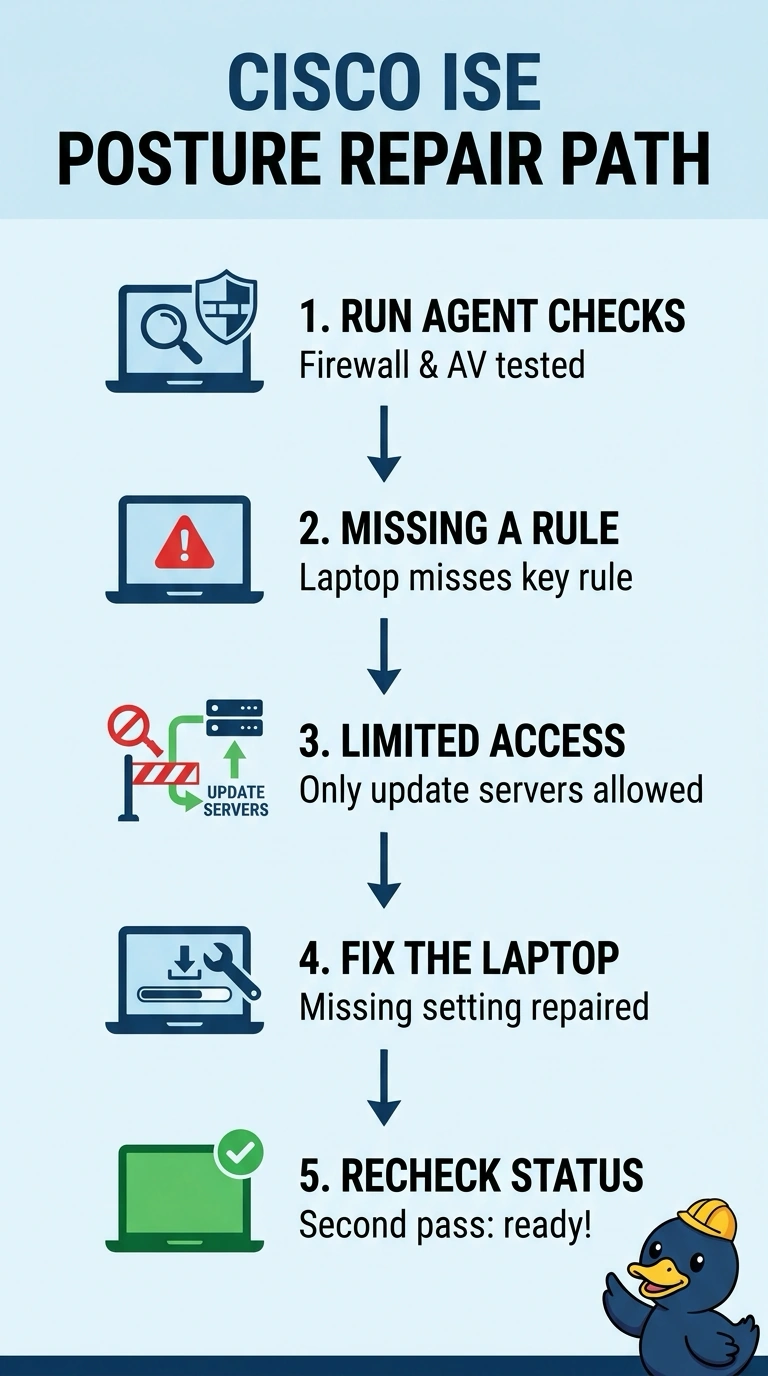
Short Explanation
Posture is a gate with two lanes: passing laptops go straight through, and failing ones get a short detour to their repair servers. Block everything and the machine can't fetch the updates that would make it compliant, while checking only antivirus ignores half the rules. Your design gives limited remediation access until both requirements are met.
Full Explanation
An ISE posture policy evaluates requirements, each one a condition such as the host firewall being enabled or the antivirus being present and current, and then places the endpoint in a compliant, non-compliant or unknown state that an authorization rule consumes. The design that meets both goals keeps the endpoint out of the file-share rule while authorizing it into a remediation profile whose rights are scoped to the update servers, so the machine can repair itself and then re-evaluate as compliant. Blocking all access until the agent reports success removes the path to the very patch that would satisfy the requirements, which strands the endpoint in an endless failing state. Granting access first and re-running the checks at the next reauthentication interval trusts the endpoint before evidence exists, so an unpatched laptop reads the share and only later discovers it should have been stopped. Verifying only the antivirus condition while assuming the corporate image supplies the firewall leaves one stated requirement untested, and images drift as soon as somebody reimages a laptop with a different build. Caveat: policy order matters, so the non-compliant rule has to sit where the traffic actually lands, and an unknown posture result is not automatically compliant. A practical check is to run a posture simulation and confirm a failing laptop reaches the update server but not the file share.