
A hospital radiology laptop fails the disk-encryption posture check after a vendor driver update hides the drive from the agent. The vendor patch ships in four days, and security needs normal access for exactly that period, then an automatic return to a failed result if the check still fails. Which Posture Work Center configuration provides that time-bound behaviour?
Select an answer to reveal the explanation.
Short Explanation
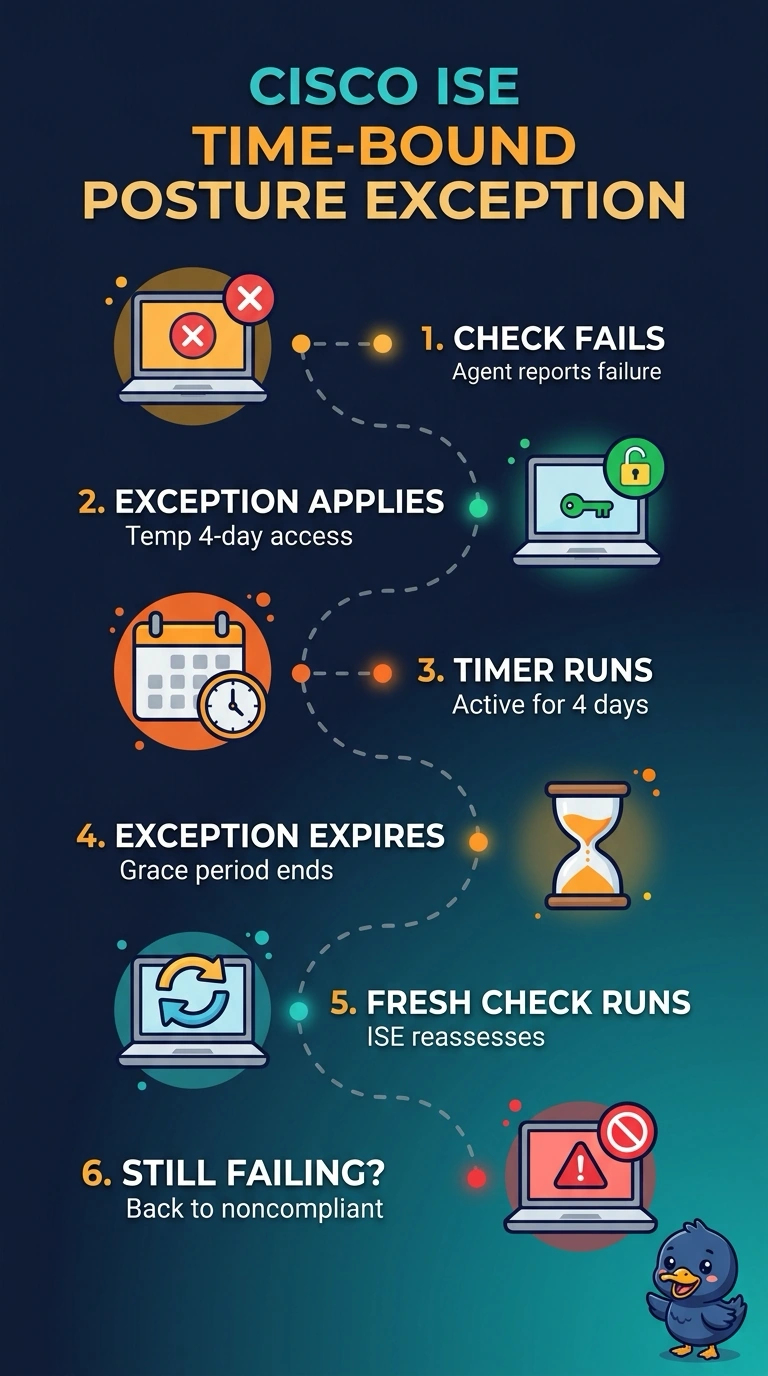
Create a four-day posture exception for the laptop and authorize its Exception posture status, so you can provide normal access until the vendor patch arrives. It’s like a temporary pass: when it expires, ISE reassesses the laptop and returns it to a failed result if the check still fails.
Full Explanation
Configure a posture exception for the endpoint with a four-day duration, and ensure the authorization policy grants the required access to endpoints in the Exception posture status. When the exception expires, ISE reassesses the endpoint; if the disk-encryption check still fails, the endpoint can return to a noncompliant result and receive the access assigned to that status. An authorization rule for NonCompliant endpoints does not itself provide a timed exception or trigger reassessment. A client provisioning policy selects or installs client software; it does not grant a posture exception. A requirement that treats the driver condition as compliant would bypass the failed check rather than provide a time-limited allowance. Practical check: verify the exception’s duration and the authorization policy for the Exception posture status.