
A university runs profiler-based identity across its campus LAN, where probe data sorts most devices into endpoint identity groups. Four laser printers run vendor firmware that sometimes omits those attributes, and print services needs their endpoint records to sit in the Legacy-Printers group for reporting. Which endpoint assignment approach keeps that group stable?
Select an answer to reveal the explanation.
Short Explanation
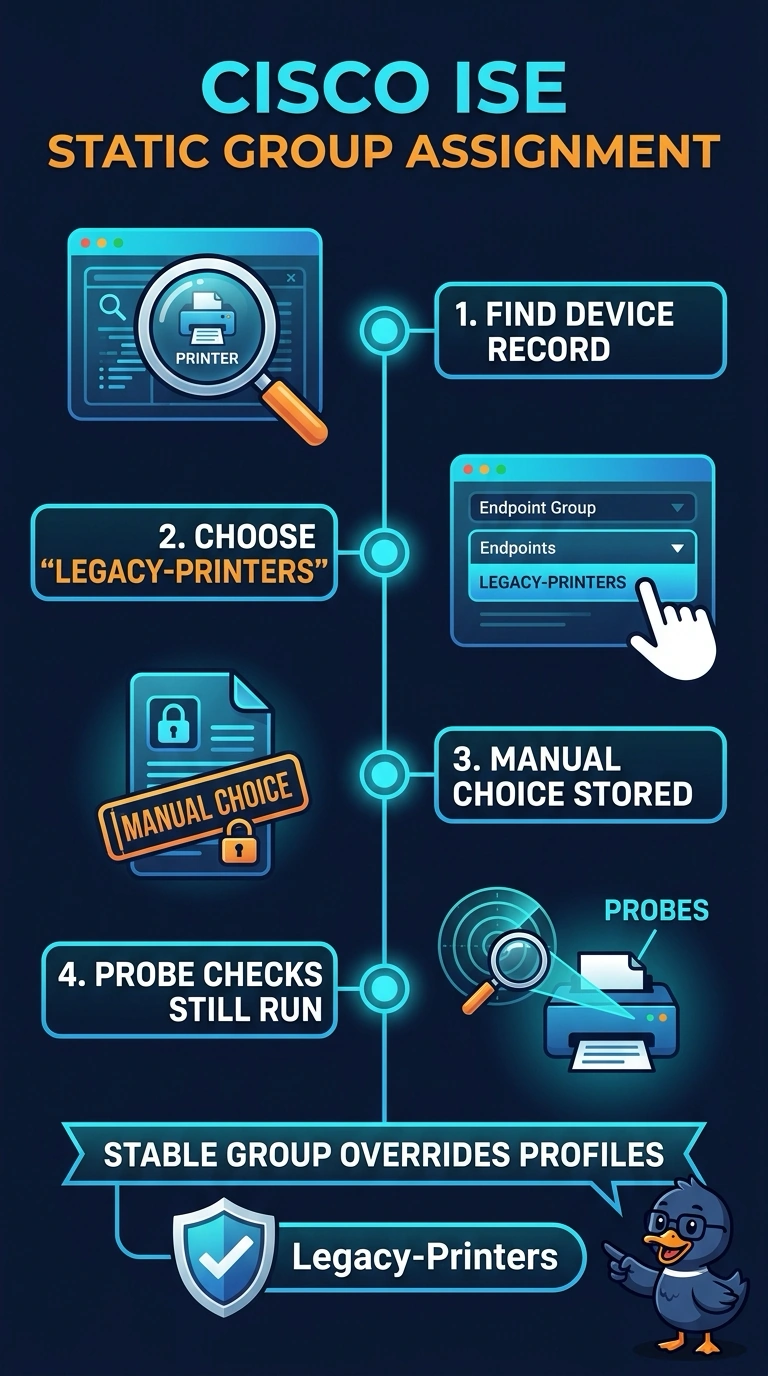
Spot on: a manual static group assignment beats whatever the profiler decides later. You're pinning a name tag on the device, so probe sweeps can look but the tag stays put. The rest of the campus keeps being profiled as usual.
Full Explanation
An endpoint record in ISE can receive its identity group from one of two places, the profiler's dynamic result or an administrator's manual choice, and when you set it by hand that value survives later profiling evaluations. That precedence makes static assignment the right tool for a device whose firmware sometimes omits the attributes probes look for, so the printers stay in Legacy-Printers for every report that reads the group. Building a profiling profile and mapping it to the group is a dynamic approach, so it only works while probe data is complete and drifts away the moment an attribute goes missing. Switching off profiling on the segment trades one problem for several, because every other device there loses automatic classification as well. An authorization rule gives a matching session the right access result, yet the endpoint identity group stays unset, so policies and reports keyed on Legacy-Printers never see those printers. Exam caveat: the screen used for manual assignment and its precedence behavior can differ by ISE release, so anchor on manual beating dynamic. Practical check: set the group on one printer's endpoint record, let profiling re-evaluate it, and confirm the group is unchanged.