
A logistics firm needs one authorization rule to cover every printer that profiling places in the Printer identity group, the same logic must be reusable in a second policy set, and re-patching cables must not change the result. Which condition should be built for that authorization rule?
Select an answer to reveal the explanation.
Short Explanation
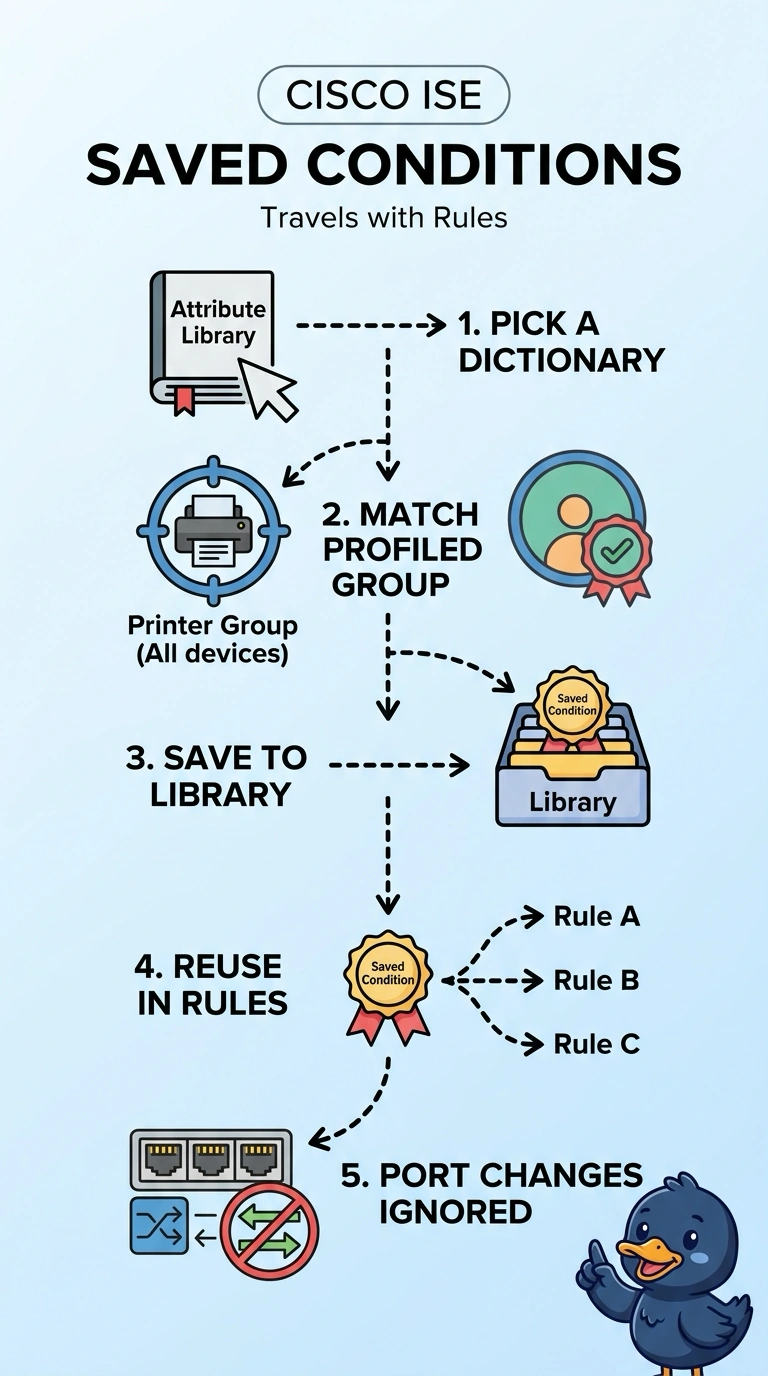
You want one match that every rule can reuse, so save it in Policy Elements instead of typing it separately into each rule. Because the match follows the profiled Printer identity group rather than cable placement, your saved condition can also be reused in the second policy set.
Full Explanation
A saved condition matching the Printer identity group expresses the intended membership once and can be referenced by rules in both policy sets. Because it relies on the profiled identity group rather than network location, moving a printer to a differently configured port should not change the match, provided profiling still assigns the printer to that group. Putting the profiled group match directly into each policy rule can cover group members and remain independent of cable placement, but it duplicates the logic rather than providing a reusable condition. A reusable condition listing known printer MAC addresses is also location-independent, but it represents a manually maintained inventory, not every endpoint profiling places in the Printer group; newly profiled members could be missed. A reusable condition for a generic printer device-type profile is not necessarily the designated Printer identity group: it may include printers outside that group or omit members classified differently. Exam caveat: distinguish a profiled identity group from a device-type classification or a static identifier list; similar labels do not guarantee identical membership. Practical check: verify that representative endpoints are assigned to the Printer identity group after profiling, then test the condition in both policy sets before and after moving a printer to another port.