
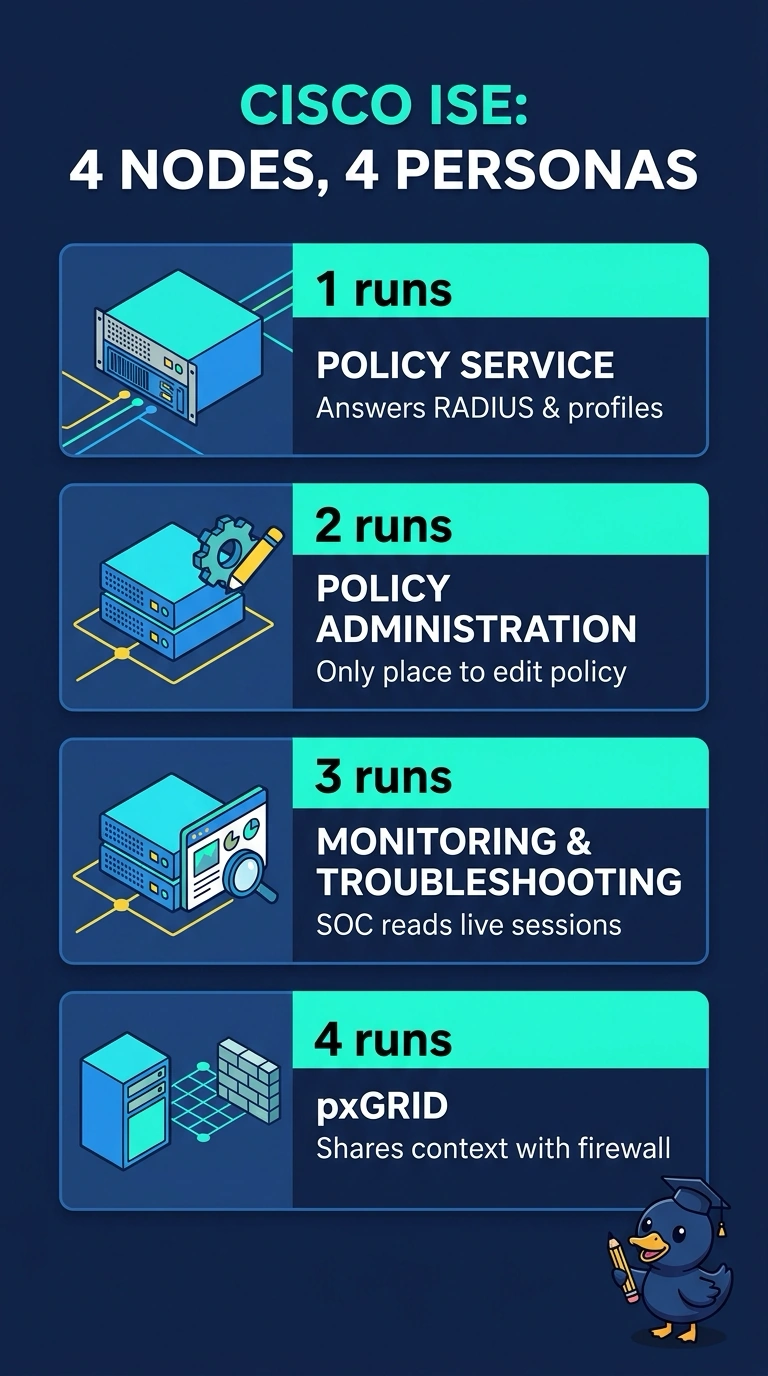
A county health system is extending ISE across four appliances. Appliance 1 must terminate RADIUS for 300 access switches and run profiling, appliance 2 is the only place engineers may edit policy, appliance 3 gives SOC analysts live sessions and diagnostics, appliance 4 shares identity and session context with the firewall. Which persona assignment satisfies each requirement?
Select an answer to reveal the explanation.
Short Explanation
A clean layout gives each box one job, so it's obvious where a problem started. The personas work like desk assignments: one signs people in, one edits the rules, and one watches the sessions. Combine them only where your requirements allow.
Full Explanation
Personas map to jobs, and each requirement here names a different one. The Policy Service node terminates RADIUS for the access switches and runs endpoint profiling on that same authentication path, which is why those two duties belong together. The Policy Administration node hosts the configuration interface and becomes the single place where rules change, so every edit passes through one controlled point. The Monitoring and Troubleshooting node provides live session information, historical records, and troubleshooting tools, while the pxGrid node publishes identity and session context for the firewall to subscribe to. Combining Monitoring onto the administration appliance still leaves appliance 3 without its required Monitoring and Troubleshooting persona, putting Policy Administration on appliance 1 breaks the requirement that appliance 2 be the only edit point, and asking Policy Service to feed the firewall leaves that integration without pxGrid. Exam caveat: smaller sites do run an all-in-one node that carries several personas at once, so the stated per-node requirements decide the answer. Practical check: open each appliance on the deployment page and confirm the enabled personas match the design before you push changes.