
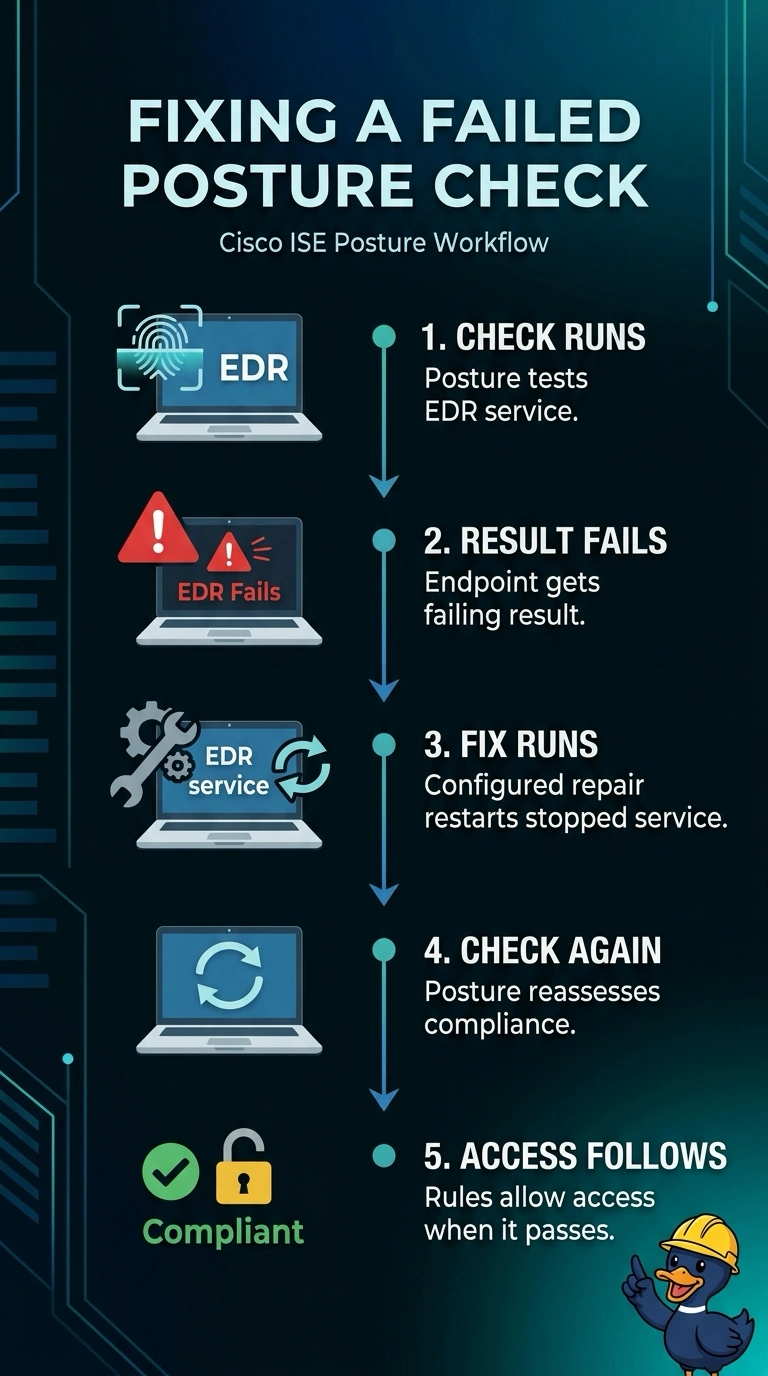
A post-production studio gates its master-footage VLAN with ISE posture. Every edit workstation must run the studio EDR with real-time scanning active; when that service stops, the editor gets a guided automatic fix and a fresh compliance check, while limited access applies until the recheck passes. Which ISE posture element performs the fix?
Select an answer to reveal the explanation.
Short Explanation
Your remediation action runs the endpoint fix, like a quick pit stop for the workstation. ISE then checks posture again, and your access stays limited until the recheck passes.
Full Explanation
The correct choice is the remediation action: ISE posture uses it to carry out the configured endpoint repair, then reassesses compliance. That sequence fits the scenario’s guided automatic fix and fresh check; restricted access can remain in place until the reassessment passes. A posture condition is appropriate for detecting whether the EDR service is stopped and evaluating the requirement. Paired with access control, it can support restricted access and another check, but detection and evaluation do not themselves repair the endpoint. Client provisioning is used to provide or update client software, such as the posture agent; it can support assessment, but installing that agent does not restart or repair the required EDR service. A help-desk workflow can give an editor sound instructions to restart EDR and can be followed by a fresh posture check, but the editor or technician performs the repair rather than an automatic endpoint remediation. Exam caveat: ISE deployments can combine conditions, authorization policies, client provisioning, and remediation, so identify the element responsible for the specific action asked about, not the whole posture workflow. Practical check: verify in the posture configuration that the remediation action targets the EDR service and that a successful repair is followed by a new assessment before full access is granted.