
A conference centre must switch on its visitor Wi-Fi on Monday. Walk-in attendees register themselves at a kiosk and go online immediately, visiting contractors must wait for their host's approval, and press badge holders only need to accept a terms page for a four-hour session. Which guest access arrangement matches all three groups?
Select an answer to reveal the explanation.
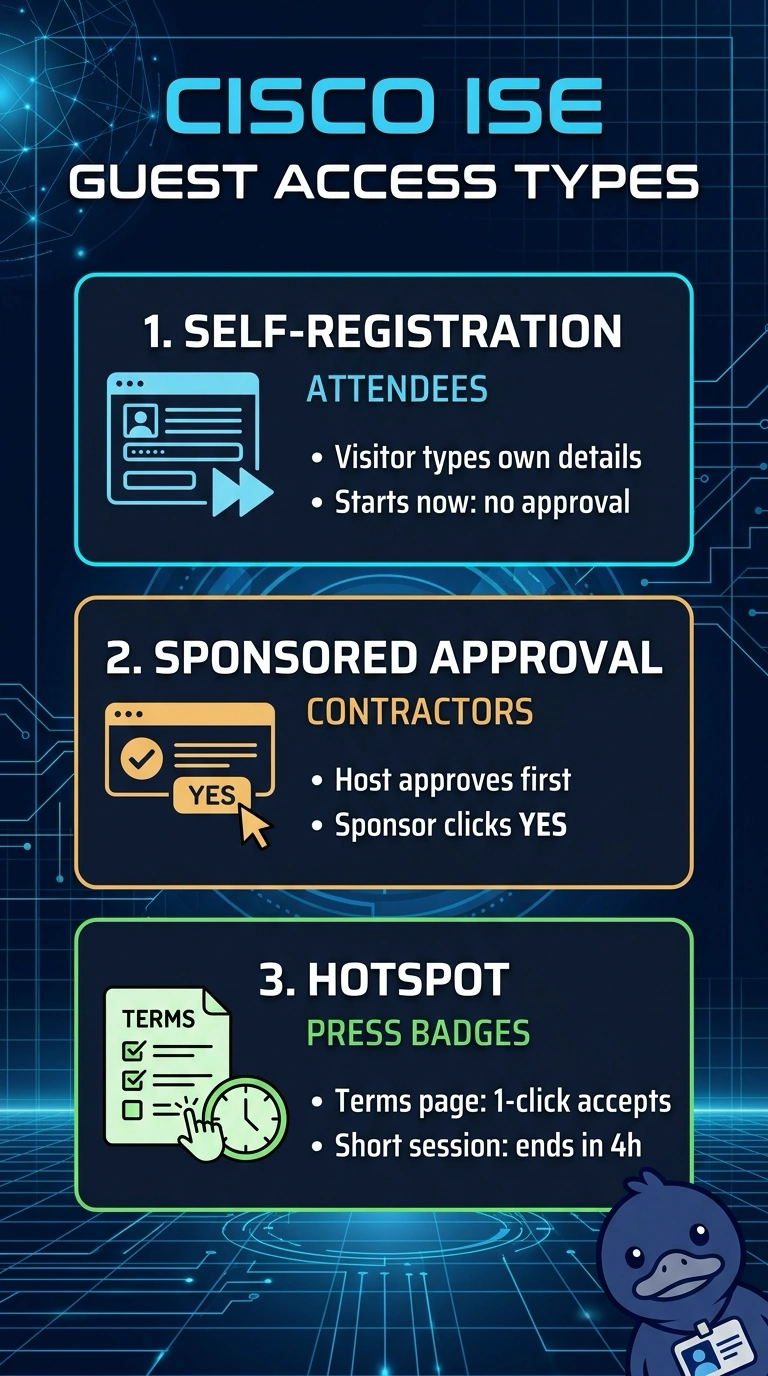
Short Explanation
You can match each group’s needs with a distinct guest access flow: kiosk self-registration gets attendees online, host approval holds contractors until authorized, and a hotspot terms page gives press a four-hour session. Sponsored approval adds the needed human checkpoint for contractors, while press can connect without waiting for a sponsor.
Full Explanation
The matching arrangement assigns an access flow to each group according to its onboarding and authorization needs: kiosk self-registration lets walk-in attendees enroll themselves and connect immediately, sponsored approval holds contractors until their host authorizes access, and a hotspot terms page gives press badge holders a four-hour session without an approval step. Requiring press holders to obtain sponsor approval adds an authorization step that their stated terms-only access does not require. Letting attendees self-register on their phones uses a familiar self-service captive-portal approach, but it does not meet the explicit requirement that they register at a kiosk. Issuing contractors time-limited guest credentials at check-in grants access without the required host approval; a time limit does not substitute for sponsorship. An exam caveat is that these labels describe policy workflows, not necessarily separate hardware: one guest platform can enforce different rules by user group. In practice, verify the group mapping, approval trigger, session duration, and actual first-login experience with test accounts before opening the network.