
A design firm will broadcast only one SSID: WPA2-Enterprise for 45 employees bringing personal laptops and phones. IT requires 802.1X on that SSID and wants employees to register their own device over the air and then keep working on the same SSID with device rights. Which BYOD flow fits these requirements?
Select an answer to reveal the explanation.
Short Explanation
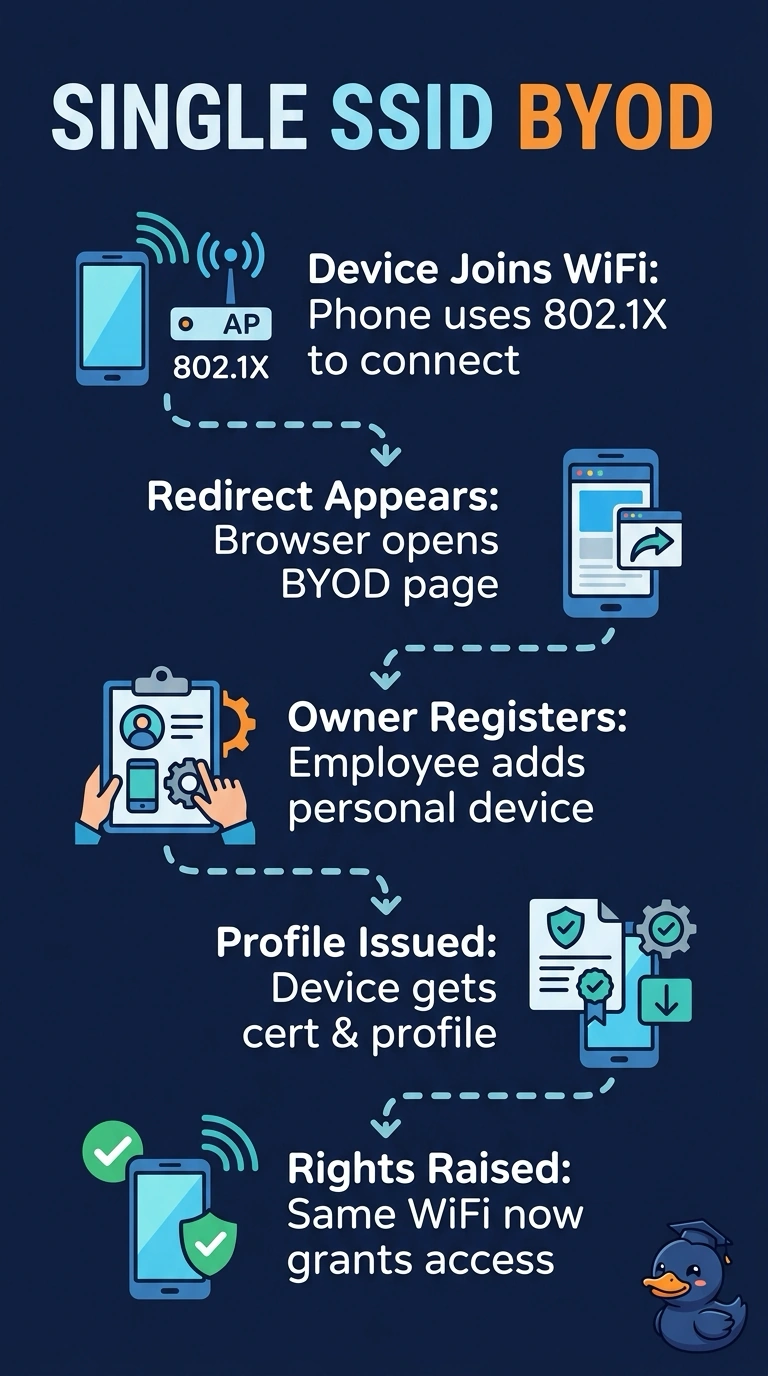
The single-SSID flow lets you onboard and keep using the same wireless network. Your device completes 802.1X on the WPA2-Enterprise SSID first, then a web redirect opens the BYOD portal for your self-registration; afterward, its device rights update without changing SSIDs.
Full Explanation
The flow that puts 802.1X before a web redirect to the BYOD portal meets the requirements: your device first authenticates to the single WPA2-Enterprise SSID, then you can register it over the air. The network can apply device-specific rights after registration while the device remains on that same SSID. A flow in which IT staff complete each employee’s registration uses the stated wireless and portal mechanisms, but it does not provide employee self-registration. A flow using WPA3-Enterprise allows employee self-registration and 802.1X, but it fails the specified WPA2-Enterprise requirement; a newer protocol is not interchangeable when the requirement names a particular one. A flow that leaves registered devices at guest-level access pending approval does not grant the required device rights after registration. Exam caveat: a portal redirect after 802.1X requires the WLAN and identity platform to support that sequence; seeing a portal does not by itself prove the client authenticated with 802.1X. Practical check: test with an unmanaged personal device and verify its EAP authentication, employee self-registration, authorization change, and continued association to the same SSID.