
Your core switch routes three client VLANs for data, voice and printers, and ISE profiles most endpoints as Unknown. Laptops send full DHCP option 55, printers rarely renew but do send HTTP user-agent strings, and the existing DHCP server must keep serving leases. Mirrored copies can be lost at peak, so DHCP from all three client VLANs must reach ISE by relay. Which setup feeds ISE that relayed DHCP plus the printers' HTTP data?
Select an answer to reveal the explanation.
Short Explanation
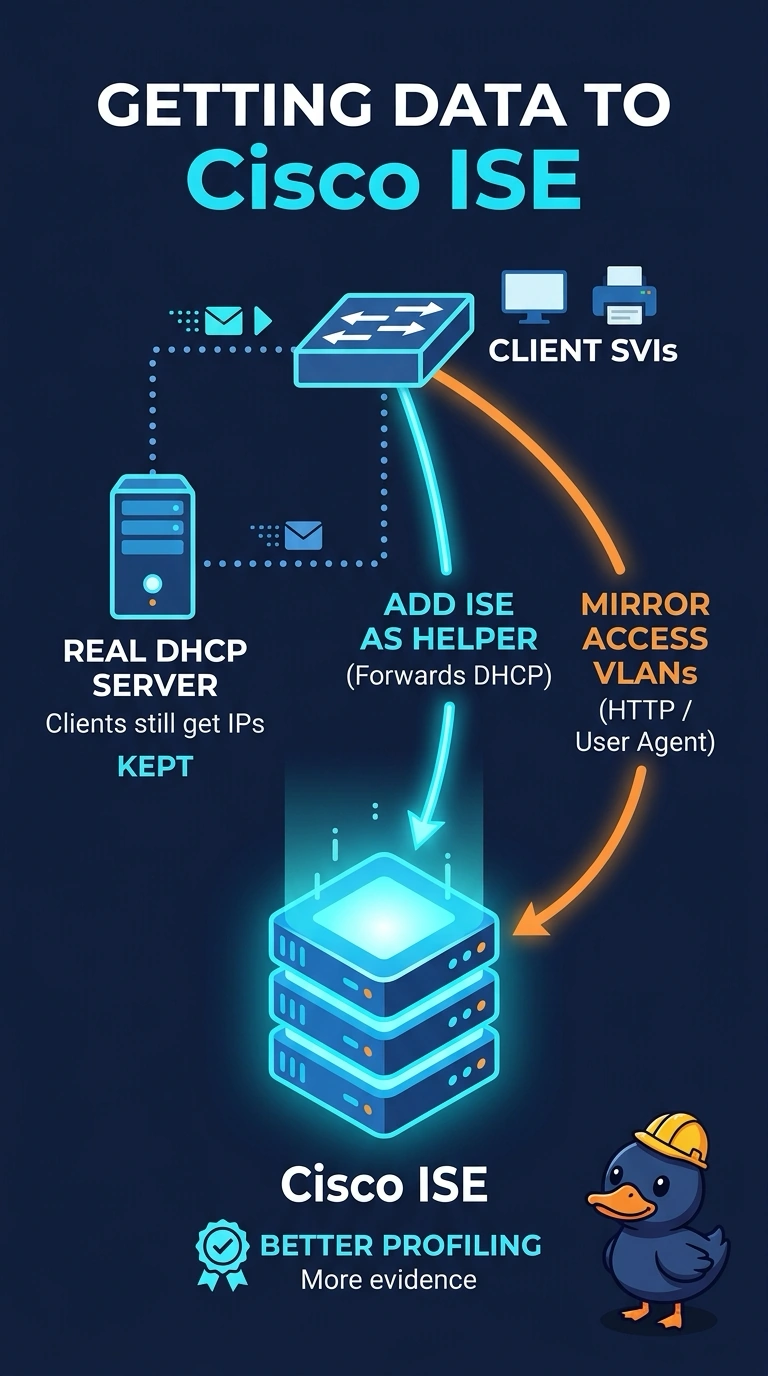
You'll need both feeds: the relay forwards DHCP broadcasts to ISE, and the mirror carries the HTTP strings printers send. It's like two witnesses at the scene, one reading the paperwork and one who overheard the conversation.
Full Explanation
The DHCP probe needs DHCP traffic from every client VLAN, and in this design that traffic reaches ISE by relay: adding ISE as an extra helper address on each client SVI sends relayed DHCP broadcasts to ISE while the existing helper entry keeps the real DHCP server in the loop, so leases keep flowing and option 55 data can reach ISE. A relay carries DHCP, so the HTTP probe needs a SPAN session mirroring the access VLANs, where printer user-agent strings and other device hints can appear. Mirroring instead of relaying fails because SPAN is best-effort and copies can be lost, while the design requires DHCP to reach ISE by relay. Relaying only the data VLAN fails because voice and printer clients sit behind their own gateways, so their DHCP broadcasts do not reach ISE by relay. Mirroring only the data VLAN fails because printer HTTP traffic is not included in that mirror, leaving the user-agent evidence out of the HTTP probe. Exam caveat: probe output also depends on the probes being enabled in the profiling policy, not on wiring alone. Practical check: watch live sessions in ISE and confirm DHCP and HTTP probe hits arrive from the relevant VLANs after the change.