
Reception at a manufacturing plant issues guest accounts to visiting engineers for a single eight-hour shift, and the same engineer often returns the next morning. Accounts stay open indefinitely, so the guest list grows daily and repeat visits create duplicates. Which guest account settings address both problems?
Select an answer to reveal the explanation.
Short Explanation
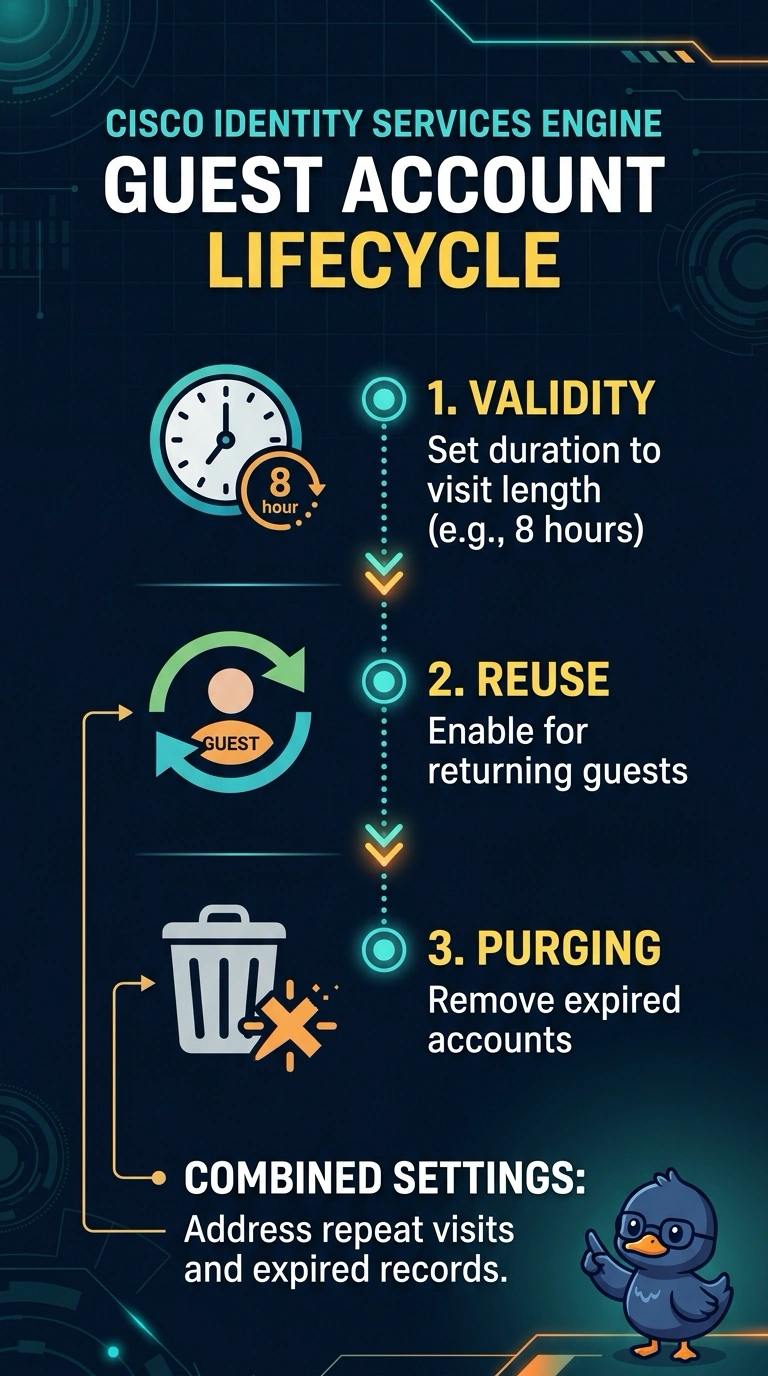
Set each guest account to expire after eight hours, enable reuse for returning engineers, and purge expired accounts. It’s like giving visitors a timed pass: you cut off access on schedule, clear out old records, and avoid duplicates when they return.
Full Explanation
The correct configuration combines three separate controls: account validity limits how long the guest account can be used, setting it to eight hours to match the shift; guest account reuse lets the system associate a returning engineer with an existing account rather than create a duplicate; and purging expired accounts removes old records so the guest list does not grow indefinitely. These controls address usability, repeat visits, and account cleanup respectively. A session-timeout approach is not a substitute for account validity: it limits a network session, while an account left valid indefinitely remains usable and stored; purging alone cannot prevent duplicates when reuse is disabled. An eight-hour reauthentication timer instead prompts the user to authenticate again and does not set account expiry or remove records; reuse without validity and purging therefore leaves accounts open-ended and the list accumulating. Setting validity and purging but disabling reuse may clean up expired records, but it does not ensure that an engineer returning before expiry is matched to the existing account. Exam caveat: account validity controls usability, not deletion, so expiry and purging are distinct. Practical check: test an account after eight hours, confirm expired records are purged, and verify a returning engineer is matched to the existing guest account; confirm the available reuse and purge behavior in your ISE release.