
The ISE profiler combines evidence from DHCP, HTTP, SNMP and NetBIOS probes when it evaluates a profiling policy, and different profiles can match the same device to different degrees. Which statement correctly describes how ISE derives a profile's certainty factor?
Select an answer to reveal the explanation.
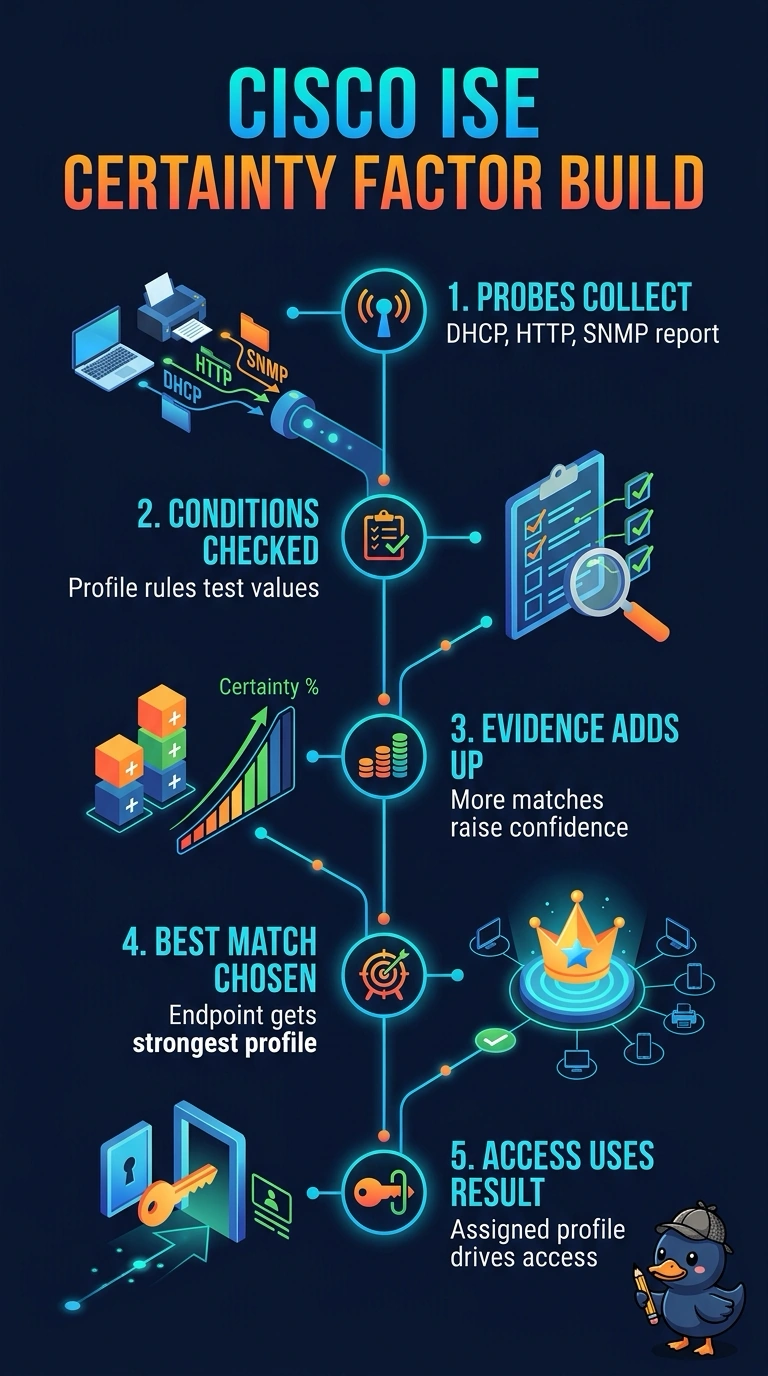
Short Explanation
Your read is right: the certainty factor is evidence-driven, so it rises as more of the profile's conditions get confirmed by probe data. It's basically a confidence meter where every extra probe result nudges the score higher.
Full Explanation
The certainty factor indicates how strongly the endpoint’s observed characteristics satisfy a profile’s conditions. ISE evaluates the evidence available from profiling probes, such as DHCP, HTTP, SNMP, and NetBIOS, against the attributes and requirements defined for that profile; the resulting factor expresses the strength of that match. A high factor therefore supports confidence in the profile match, while a lower factor indicates that fewer or less persuasive conditions are satisfied. Taking only the strongest individual probe match would discard relevant evidence from the other probes, so it would not represent the combined basis for profiling. Comparing a profile’s score with competing profiles instead would make certainty depend on other candidate profiles’ relative rankings, rather than on how well this profile’s own conditions are met. Using only the latest probe snapshot would likewise fail to evaluate the collected evidence together, since information from earlier observations could still contribute to the profile match. Exam caveat: do not confuse profiling certainty with an authorization result; authorization policies can use endpoint identity or profile information, but they do not define the profile’s certainty factor. Practical check: inspect the endpoint’s live profiling details and the matched profile attributes, then confirm which probe observations support the match and how the displayed certainty changes as evidence is received.