
Posture in ISE keeps requirement definitions separate from the code that runs checks on the endpoint. A hospital wants its full-disk encryption and antivirus checks to stay current as new Windows 10 and macOS builds ship, with every requirement authored in one place inside ISE. Which source defines the posture requirements that the endpoint agent evaluates?
Select an answer to reveal the explanation.
Short Explanation
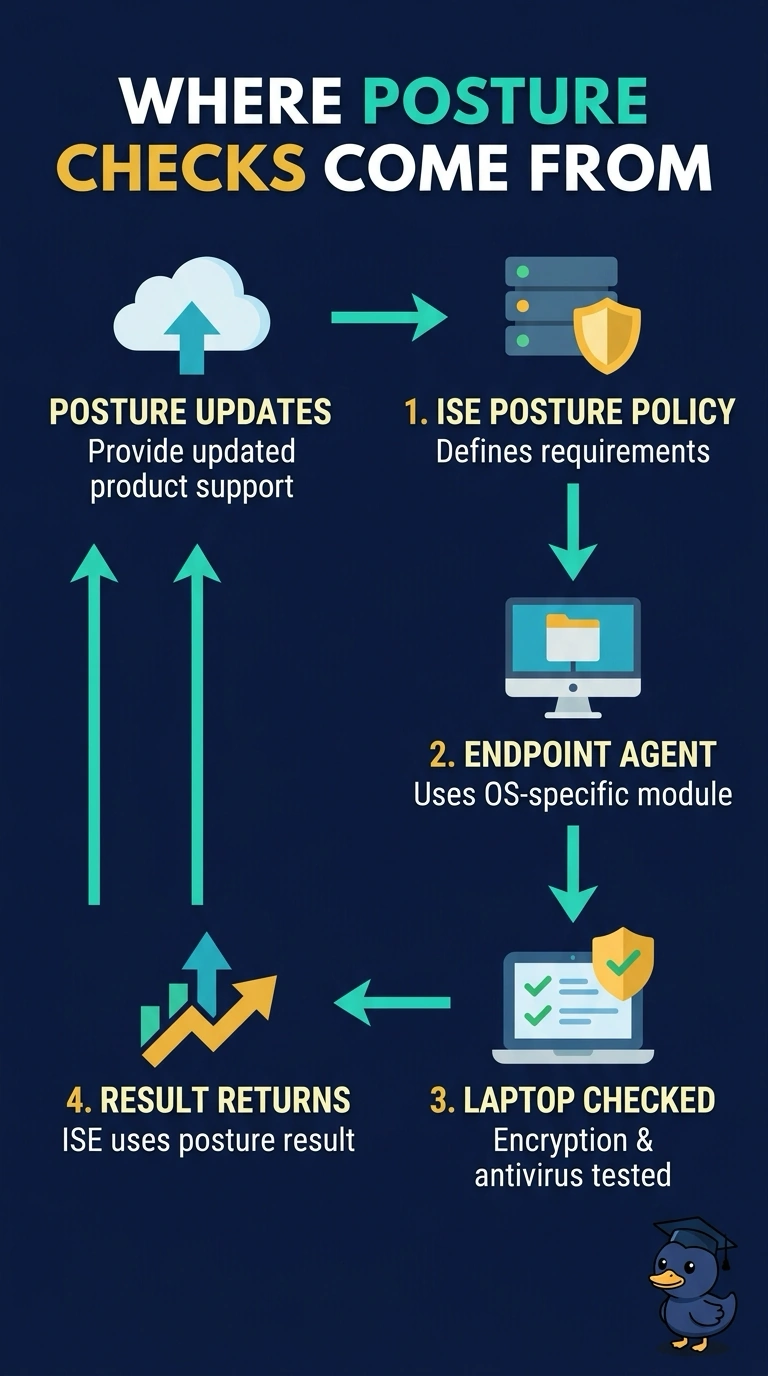
ISE posture policies define the requirements; the endpoint's compliance module runs the checks. Posture updates provide updated support content for operating systems and security products, but they do not replace the policies you configure in ISE.
Full Explanation
ISE posture policies define the requirements and conditions used to determine whether an endpoint is compliant. The endpoint agent uses a supported compliance module for its operating system to run checks and report the posture result to ISE, which can use that result in authorization. ISE posture updates provide updated support content for operating systems and security products; they do not author hospital-specific requirements or replace posture policy configuration. Compliance modules are operating-system-specific, so a single module does not perform checks identically across Windows and macOS. In this scenario, the requirements are authored in ISE, while the module evaluates them on the endpoint.