
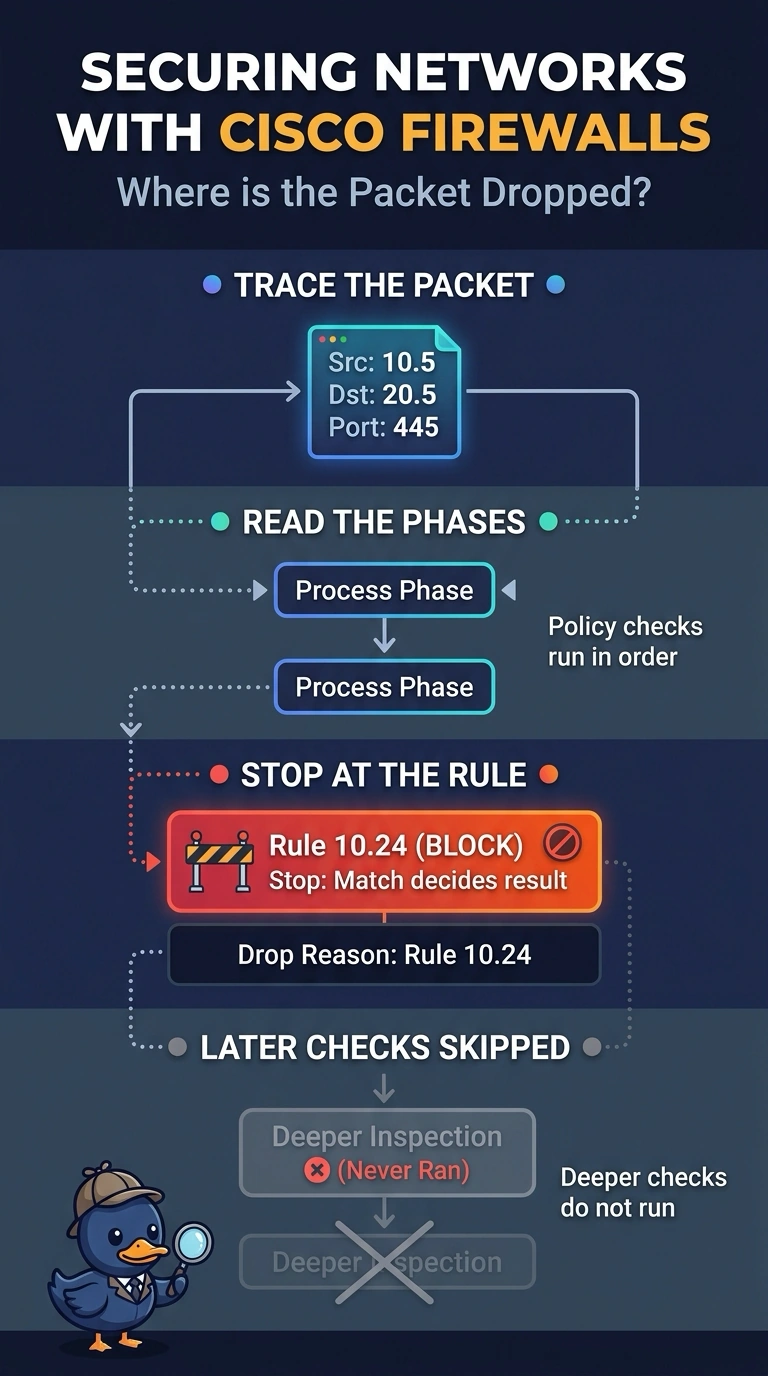
Users report that a file share at 10.5.20.5 stopped responding, so an engineer runs Packet Trace from 10.5.10.24 toward TCP 445. The output shows the access control evaluation matched rule 'Legacy-SMB-block' and blocked the packet, with no intrusion or file sections following. What does this output indicate about the drop reason?
Select an answer to reveal the explanation.
Short Explanation
The trace stops at the phase that made the decision, so the named rule is your drop reason. It's like a guard turning someone away at the lobby desk — the access control rule never lets the packet reach the deeper inspection desks.
Full Explanation
Packet Trace simulates how your deployed policy treats one hypothetical packet, and in Threat Defense the access control rules are evaluated before any intrusion or file inspection runs. Because rule 'Legacy-SMB-block' matched and blocked, the policy made its decision at the access control phase, so evaluation ends there and no intrusion or file policy applies to this packet; that rule is the drop reason. Explaining the output as an endpoint refusal mistakes a connectivity test for policy simulation, since the tool never talks to the server or reports its response. Blaming a missing route cannot explain a named rule match, because the tool reports routing as its own lookup and this output already shows access control evaluation completing. Putting the intrusion policy first reverses the inspection order, as intrusion only runs on traffic the access control rules already allowed. Exam caveat: the trace models a single packet without session state, so an allow result does not prove the whole conversation succeeds. Practical check: change the offending rule's action or scope, redeploy the policy, and re-run the trace to watch the result flip.