
A retail company runs ten supported Secure Firewall Threat Defense virtual appliances across AWS VPCs and its on-premises hypervisors. Operations has no capacity to deploy or patch another management virtual machine, and administrators need a single console that applies consistent policy everywhere. Which management option best fits these ten virtual appliances?
Select an answer to reveal the explanation.
Short Explanation
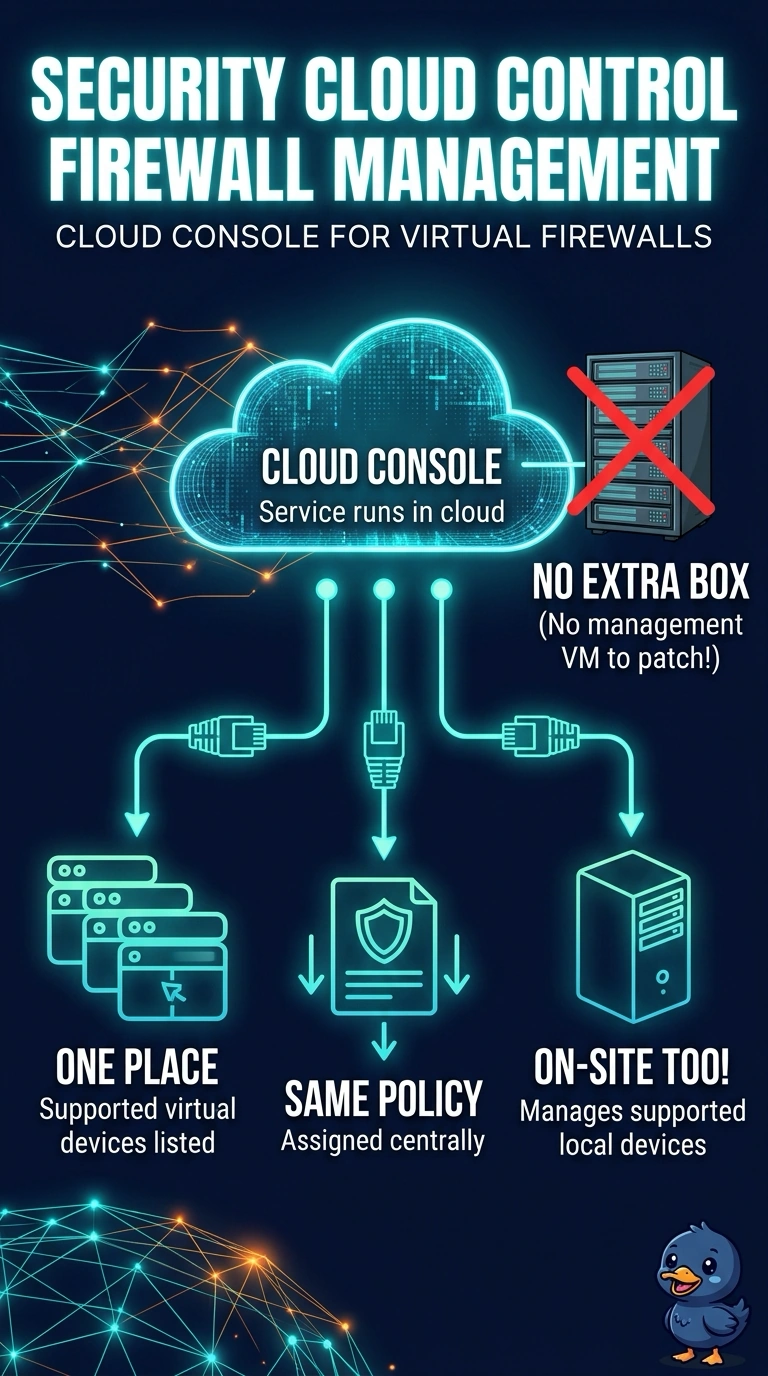
Security Cloud Control Firewall Management is a hosted console, so your team does not build or patch a management box. You get the control room without the construction work — it's already furnished.
Full Explanation
Security Cloud Control Firewall Management is delivered as a hosted service, and its cloud-delivered Firewall Management Center runs as software that Cisco deploys and maintains for you. The console and its managed policy are in the cloud, so your operations team does not size, patch or upgrade a management instance. For supported virtual appliances, it provides a central device list and lets administrators assign policy centrally. A Management Center virtual machine would give you central policy and event aggregation, but it fails the explicit capacity requirement because you would still have to deploy, size, patch and back up that instance yourself. The on-box Device Manager also avoids a separate server, yet it is per-device by design, so it cannot deliver one console with consistent policy across ten appliances. A shared configuration template pushed over SSH removes the extra server too, but it relies on manual application and version-control discipline rather than central enforcement, and it does not provide centralized event management. Cloud management still requires outbound connectivity and appropriate licensing and device support. Verify that every appliance appears in the console and has the intended policy assigned.