
A retailer runs FTD Virtual instances in AWS and Azure, and its infrastructure is entirely in the public cloud. The team wants one console for policy and objects, prefers that Cisco hosts and patches the manager, and plans to onboard a supported release. Which cloud management option fits these requirements?
Select an answer to reveal the explanation.
Short Explanation
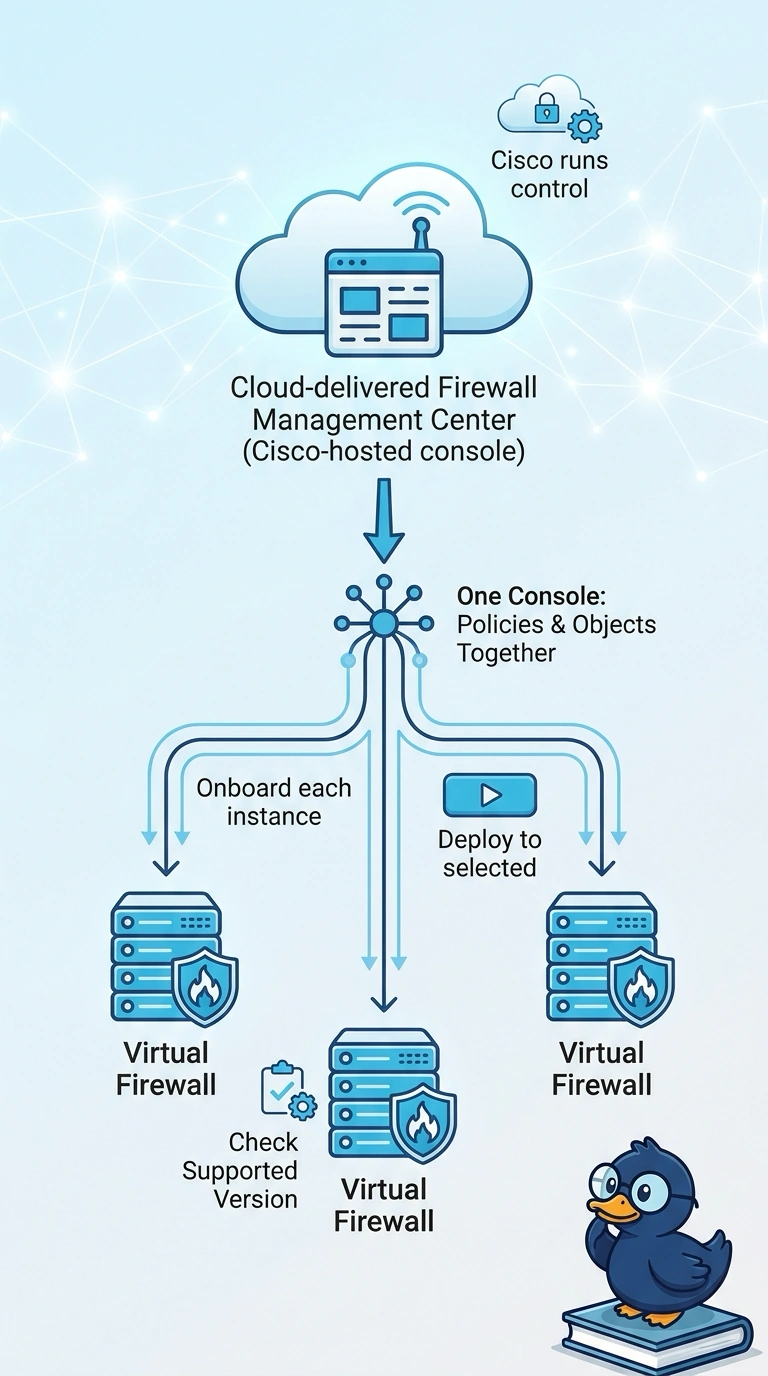
You can use the cloud-delivered Firewall Management Center for one Cisco-hosted console across your AWS and Azure FTD Virtual instances. The other listed approaches either have a partner or your team host and maintain the manager, or use separate consoles for each cloud.
Full Explanation
The cloud-delivered Firewall Management Center fits because it provides one console for policies and objects across the AWS and Azure FTD Virtual instances, while Cisco hosts and maintains the manager. It is also the intended cloud-management choice when you plan to onboard a supported release and keep your infrastructure in the public cloud. Having a cloud-services partner host and patch an FMC Virtual in AWS could centralize management of both fleets, but the partner—not Cisco—would host and patch the manager, contrary to your preference. Deploying and maintaining a supported FMC Virtual in AWS could also manage FTD instances in both clouds from one console, but your team would be responsible for the manager rather than relying on Cisco to host and patch it. Separate Cisco-hosted cloud-delivered FMC consoles would preserve Cisco-hosted management, and each could manage its own cloud fleet, but they would not provide the requested shared console. Exam caveat: verify that the specific FTD release and features are supported by the chosen management service; public-cloud deployment alone does not establish compatibility. Practical check: confirm the release in Cisco’s compatibility guidance, then validate that both cloud accounts and all intended devices can be onboarded to the same management tenant.