
A regional hospital is standing up its first virtual Management Center to manage four FTD virtual appliances in its private cloud and two physical FTD appliances in clinics that use carrier-assigned addresses for the contract year. The vFMC cannot open sessions to the clinics, but the clinic appliances can reach the vFMC. The clinics cannot be readdressed or given inbound reachability during the contract year. Which registration approach lets all six devices join this single Management Center?
Select an answer to reveal the explanation.
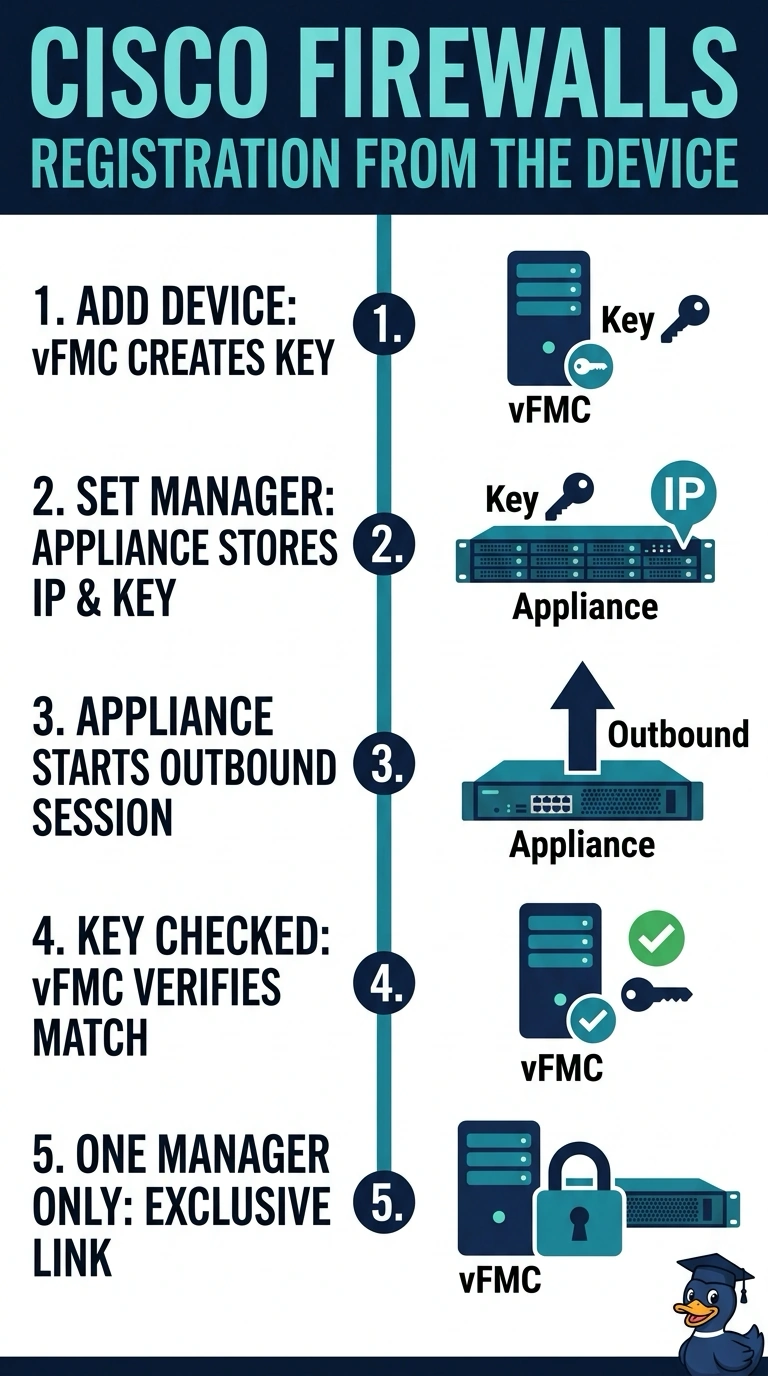
Short Explanation
You've got a one-way path here: the clinics can dial out, but the manager can't walk in. Each appliance starts the session itself using a registration key the vFMC created for it, so carrier addressing never enters the picture.
Full Explanation
The correct approach is to add each appliance to the vFMC with a registration key and let the appliance initiate registration. That matches the available network path: the clinics can reach the vFMC, but the vFMC cannot open sessions to the clinics. It also keeps all six devices under the one Management Center. Managing the clinic appliances locally with FDM is a common choice when centralized management is not required, but it leaves those two devices outside the vFMC and therefore fails the single-Management-Center requirement. A site-to-site VPN can provide routed connectivity between sites, but this proposal depends on the vFMC initiating sessions across that tunnel. It would give the clinics the inbound reachability the scenario explicitly rules out; a tunnel does not remove that requirement merely because it is encrypted. A second vFMC is also a familiar way to manage devices at a remote site, but it splits management across two centers rather than joining all six devices to the one specified vFMC. Exam caveat: registration direction and ongoing management connectivity are related but distinct; confirm which side initiates the needed connections rather than assuming that a registration key alone creates network reachability. Practical check: verify that each clinic appliance can resolve and reach the vFMC over the required management path, and that its key and registration settings match the device entry on the vFMC.