
A small team manages five FTD appliances and must keep their syslog, NTP and login banner settings identical with a single edit later, run the same interface and process health checks on all five, and install a company CA-signed certificate on each appliance. Which configuration approach covers all three needs?
Select an answer to reveal the explanation.
Short Explanation
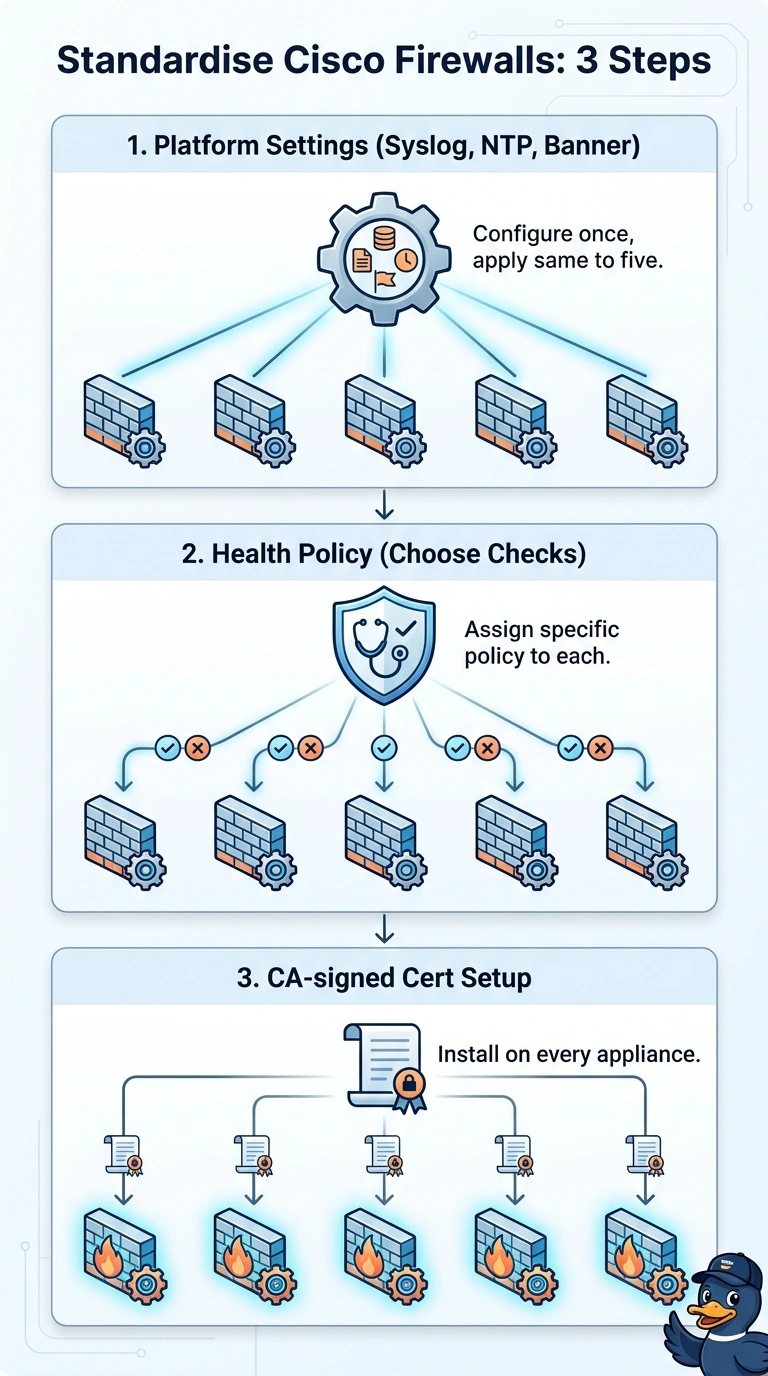
You can keep syslog, NTP, and banner values consistent with one shared platform settings policy, then make a later change once for all five appliances. Assign a health policy to each appliance for the interface and process checks, and install the CA-signed certificate on each one. That gives you centralized settings without skipping the per-appliance health checks or certificates.
Full Explanation
Configuring platform settings once for all five appliances, assigning a health policy to each, and installing the CA-signed certificate on every appliance meets all three requirements. The shared policy lets you make a later syslog, NTP, or banner change once and deploy it consistently; health policies enable the same interface and process checks on each appliance; and each appliance receives its required certificate. Entering those settings individually on every appliance still allows health policies and per-appliance certificates, but a later change must be repeated five times, so it does not provide single-edit management. Applying shared settings and monitoring interface counters in the FMC dashboard does not assign a health policy to run the required interface and process checks. Applying shared settings and assigning health policies, but configuring the identity certificate on the Management Center only, does not install the certificate on each managed FTD appliance. Exam caveat: platform settings policies and health policies serve different purposes; one does not replace the other. Practical check: after deployment, verify the shared policy is associated with all five devices, each reports the intended health checks, and each appliance’s certificate store contains the certificate and expected chain.