
A bank runs 18 Secure Firewall Threat Defense appliances across four data centers in an air-gapped network with no internet route. The team needs shared objects, one place to correlate events, and health checks for every appliance. Which management tool should the team deploy for this on-premises estate?
Select an answer to reveal the explanation.
Short Explanation
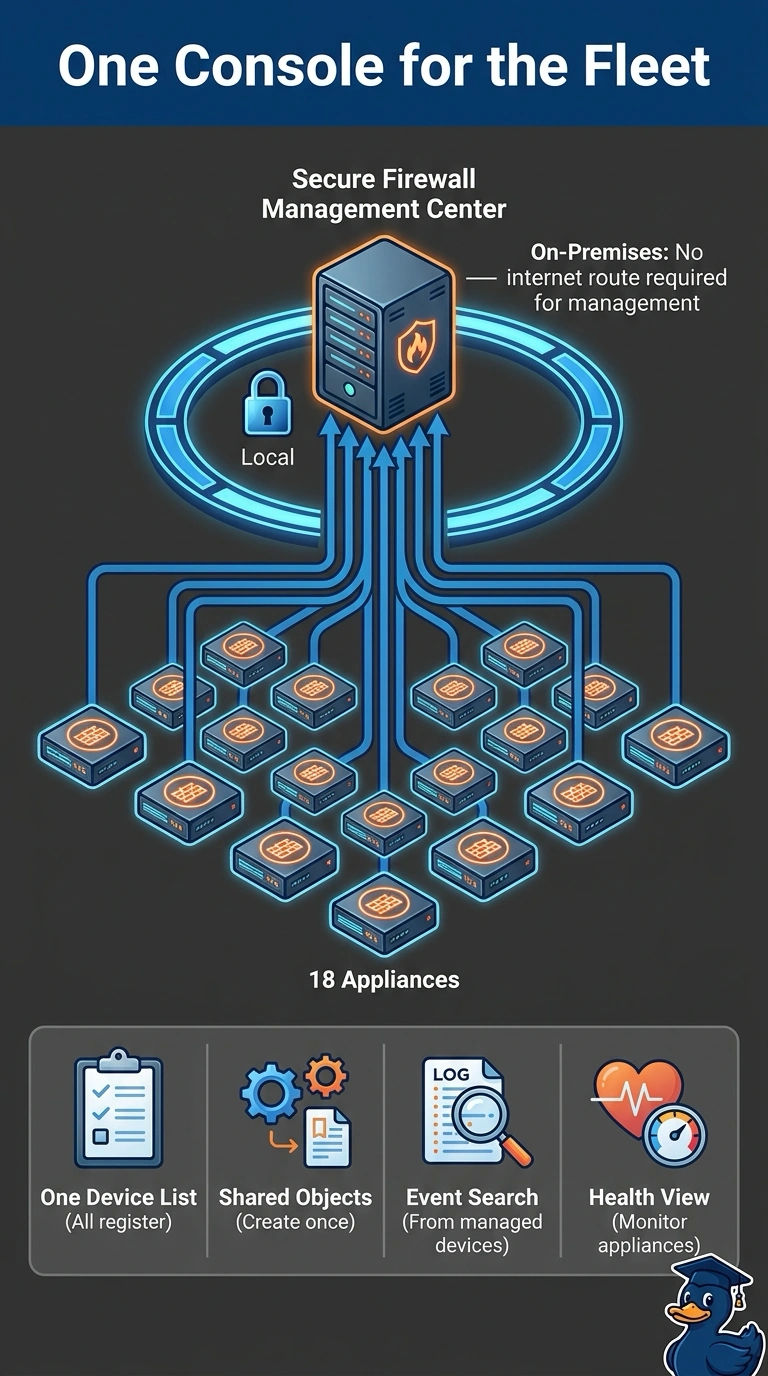
With no internet route, you can deploy Management Center on-premises and register all 18 appliances to one console—a shared control room for objects, events, and health checks. You’ll just need to plan licensing and updates for the offline environment.
Full Explanation
Deploying one on-premises Secure Firewall Management Center and registering all 18 appliances meets the requirements directly: the team can maintain shared objects centrally, review and correlate events in one management console, and check appliance health across the estate. The air-gapped network makes an on-premises deployment appropriate without relying on internet connectivity. Separate Management Centers at each data center, even with a central SIEM and NMS, split object management across four independent consoles; the SIEM can consolidate events, but it does not make the Management Centers’ objects shared. Device Manager on each firewall is a viable approach for smaller or independently managed deployments, and Ansible, a SIEM, and an NMS can automate configuration and consolidate monitoring. However, those tools do not provide the required shared objects in one native management console; automated copies of objects are not the same as centrally managed shared objects. Managing 17 appliances through Management Center and the last through Device Manager leaves one appliance outside the common management console, so it fails the requirement to cover every appliance in that console. Exam caveat: distinguish centralized event collection or configuration automation from centralized firewall management; they do not necessarily provide shared objects. Practical check: confirm that the selected on-premises Management Center release supports the deployed FTD versions and capacity for all 18 appliances, and verify registration and health reporting in the air-gapped environment.