
A regional office has two Secure Firewall Threat Defense appliances in one rack. Peak traffic stays well within a single appliance, the budget allows only those two units, and existing sessions must survive a hardware failure while one unit handles production traffic at a time. Which high availability design meets the capacity and session requirements?
Select an answer to reveal the explanation.
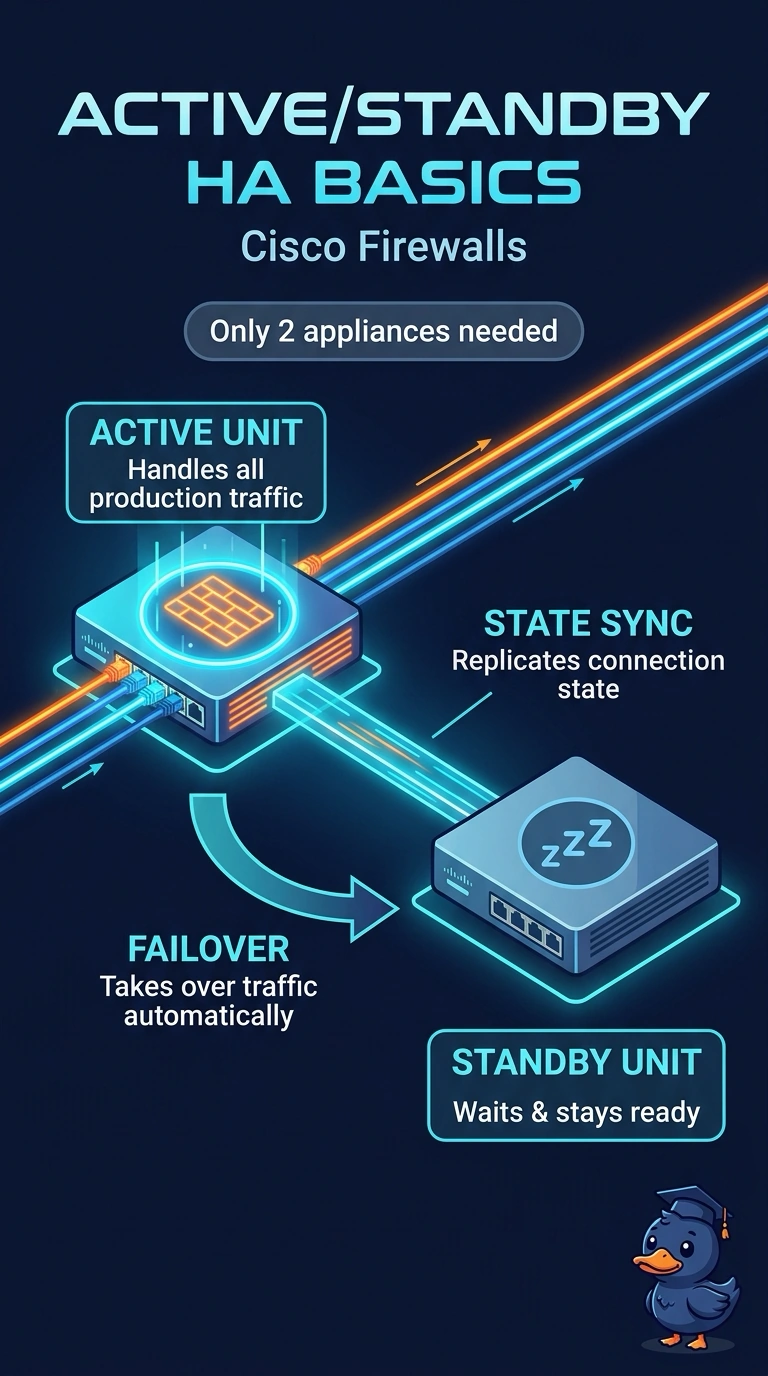
Short Explanation
An active/standby HA pair fits your two-unit rack, with one appliance carrying traffic and the other synchronizing connection state. It's like a spare tire already inflated on the rim, ready the moment a wheel goes flat. You keep session continuity without load sharing; unlike active/standby, clustering forwards traffic across nodes.
Full Explanation
Secure Firewall Threat Defense active/standby HA synchronizes connection state from the active appliance to the standby, so after a hardware failure the standby can take over with session continuity for supported connections. That suits a two-appliance site whose traffic fits in one device and requires one unit to handle production traffic at a time. An FTD cluster forwards traffic across nodes, so it does not meet that one-unit-at-a-time requirement. Two independent devices with matching policies do not synchronize connection state, so established sessions may be lost when traffic is rerouted. A routing redundancy protocol can move a gateway address, but does not transfer the firewall connection table. Exam caveat: a management center manages an active/standby pair as a single logical device, so you plan one policy for the pair rather than per box. Practical check: force a failover in a change window and verify whether established sessions survive.