
A retail chain places four Secure Firewall Threat Defense nodes in a cluster behind a load balancer to absorb peak traffic. Which member coordinates cluster-wide control-plane functions while all members forward production traffic?
Select an answer to reveal the explanation.
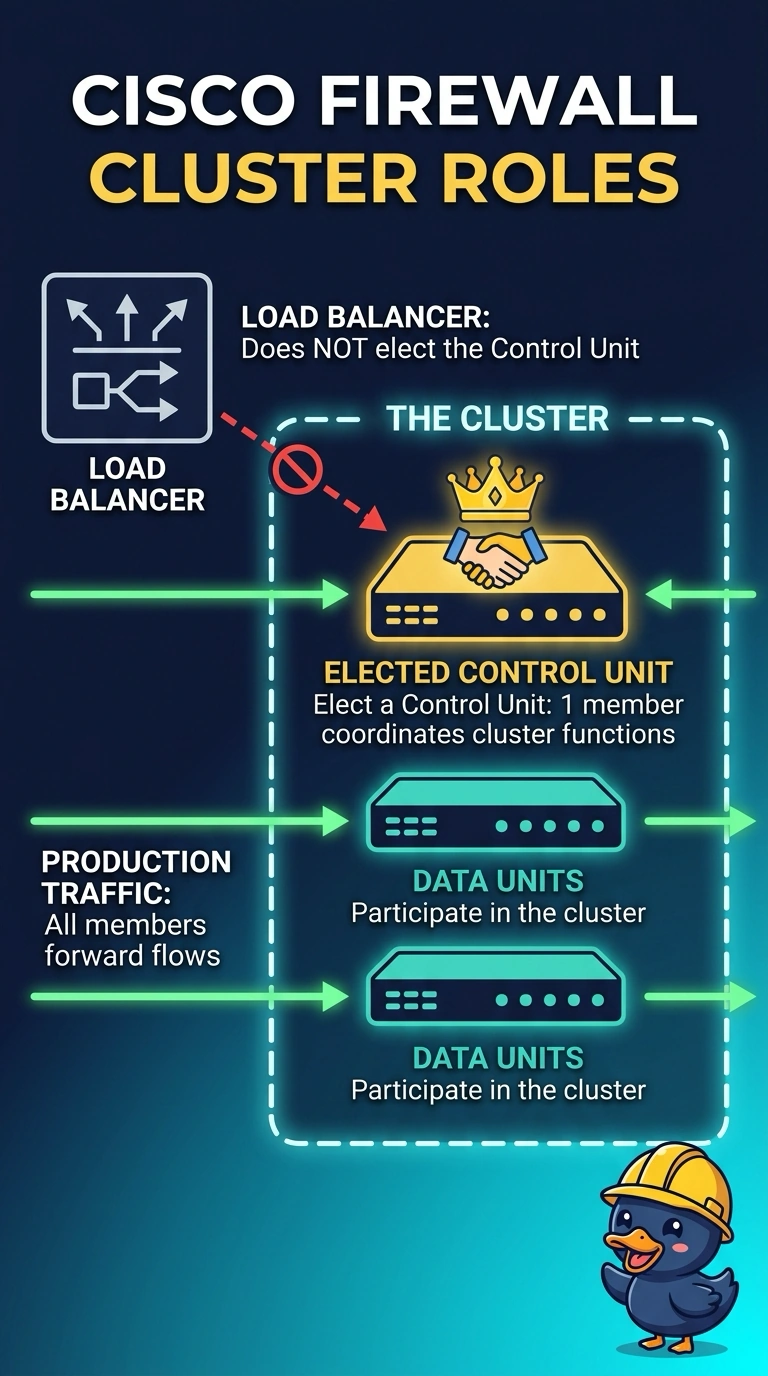
Short Explanation
Your cluster elects a control unit to coordinate shared control-plane tasks, like a team captain organizing the play. All four members can still forward production traffic.
Full Explanation
The elected control unit is the cluster’s coordinator for shared control-plane functions, such as maintaining cluster-wide state and coordinating the members. The remaining members operate as data units; they are not passive backups, and every member can forward production traffic. The independent-coordination approach is incorrect because it assigns cluster-wide coordination separately to each data unit, rather than to the one elected control unit. The standby-unit approach confuses clustering with an active/standby design: a data unit is not waiting to take over only after a control-link failure, and the cluster’s control role is elected. The load-balancer-coordination approach confuses traffic distribution with firewall cluster control. A load balancer may direct traffic to members, but it does not elect the control unit or coordinate cluster-wide functions. Exam caveat: a control unit does not imply one shared cluster management address, nor does it mean administrators must make configuration changes on that unit. Management interfaces have per-unit addresses, and configuration management depends on the management method and deployment. Practical check: inspect cluster status to identify the elected control unit and data units, then confirm that the members are forwarding traffic as expected.