
A regional streaming company is consolidating two data center edge sites into one security platform. Traffic must be distributed across appliances that all forward traffic simultaneously, aggregate throughput must grow as units are added, one appliance must own cluster health and configuration, and state must stay synchronized across units. Which high availability and scaling design meets the throughput, role, and state requirements?
Select an answer to reveal the explanation.
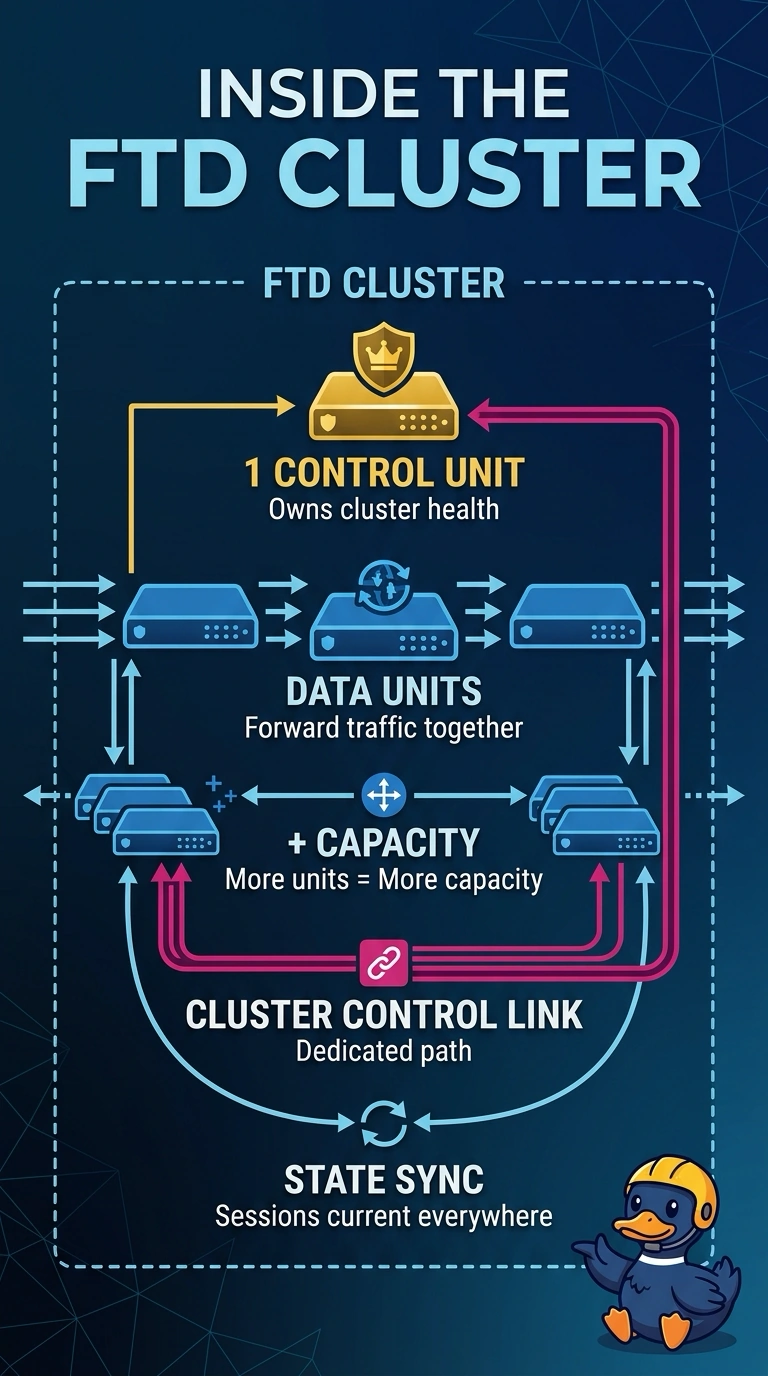
Short Explanation
You’re looking for an FTD cluster: its control unit owns health and configuration while data units forward traffic together, so adding data units grows aggregate throughput. The cluster control link synchronizes state and coordination, keeping the units in step.
Full Explanation
An FTD cluster meets the requirements because one control unit owns cluster health and configuration while the data units forward traffic simultaneously. Adding data units grows aggregate forwarding capacity, and the dedicated cluster control link carries coordination and state information to keep the units synchronized. A fixed active-active firewall pair can split traffic across both peers and synchronize sessions, but it is still a fixed pair; scaling requires a separate pool rather than adding members to grow that pair’s capacity. A load-balanced pool of independent firewalls can forward traffic across appliances and grow as units are added, with a manager overseeing health and configuration, but the design as described does not specify synchronized state across units. A scale-out firewall fabric can provide simultaneous forwarding, added capacity, and synchronized session state, but distributed control does not provide the required single appliance owning cluster health and configuration. Exam caveat: active-active forwarding alone does not mean that adding members increases aggregate throughput, and management oversight is not necessarily cluster control ownership. Practical check: verify the platform’s documented cluster roles, supported member count, state-synchronization path, and measured throughput scaling for the intended traffic mix.