
A retailer plans to group four appliances at the distribution center into a cluster so aggregate throughput grows beyond a single box while the site stays online if one appliance dies. The network team needs the roles, configuration handling, and the intra-cluster wiring documented before cabling begins. Which statement about cluster roles, configuration, and the cluster control link is correct for this design?
Select an answer to reveal the explanation.
Short Explanation
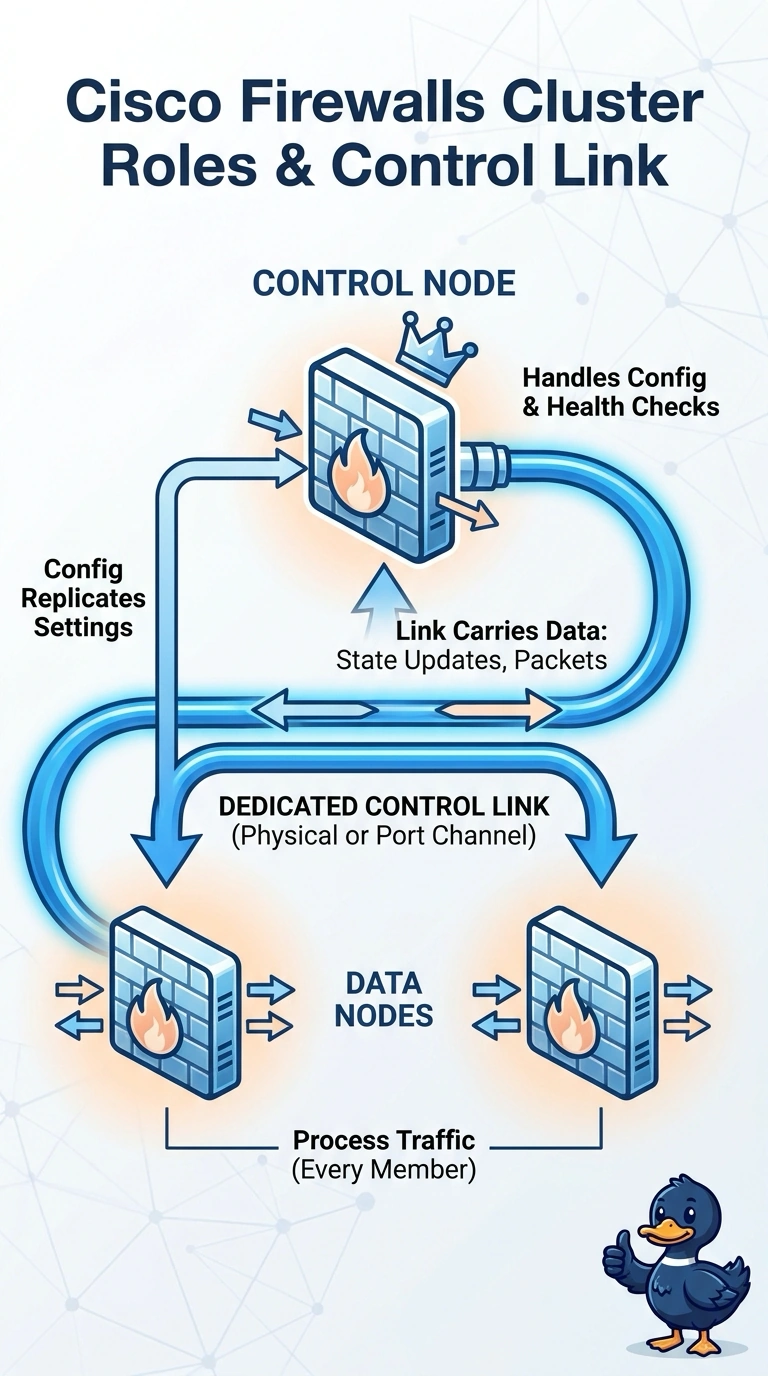
You get one control node to replicate configuration, while all four members process traffic and contribute to throughput. Each appliance dedicates an interface to the private control link, keeping coordination and state communication separate from production traffic.
Full Explanation
The correct design has one control node replicate configuration to the other members, while all four appliances process traffic and contribute to aggregate throughput. Each appliance dedicates an interface to the intra-cluster control link, separating cluster communication from production traffic. Independent FMC deployment of matching configuration is a different configuration model: the control node, rather than separate deployments to each member, replicates configuration. Carrying cluster control over a shared production interface misses the dedicated-interface requirement, even if the control node replicates configuration and all members process traffic. Keeping one appliance as a hot standby also fails the all-member processing model: that unit does not contribute normal traffic-processing capacity, although the remaining three can process traffic. Exam caveat: terminology and exact control-link duties can vary by product and software release, so do not assume every cluster platform uses the same interface or synchronization design. Before cabling, check the vendor’s supported cluster topology and interface requirements for the specific appliance model and release; verify that the planned links, bandwidth, and failure behavior match the deployment guide.