
A bank is clustering eight identical Secure Firewall Threat Defense appliances to raise data center throughput. The design must deliver four things: higher aggregate throughput, one single Management Center view, session state that survives losing the leadership unit, and cluster chatter kept off the production interfaces. Which role and cluster control link arrangement meets all four requirements?
Select an answer to reveal the explanation.
Short Explanation
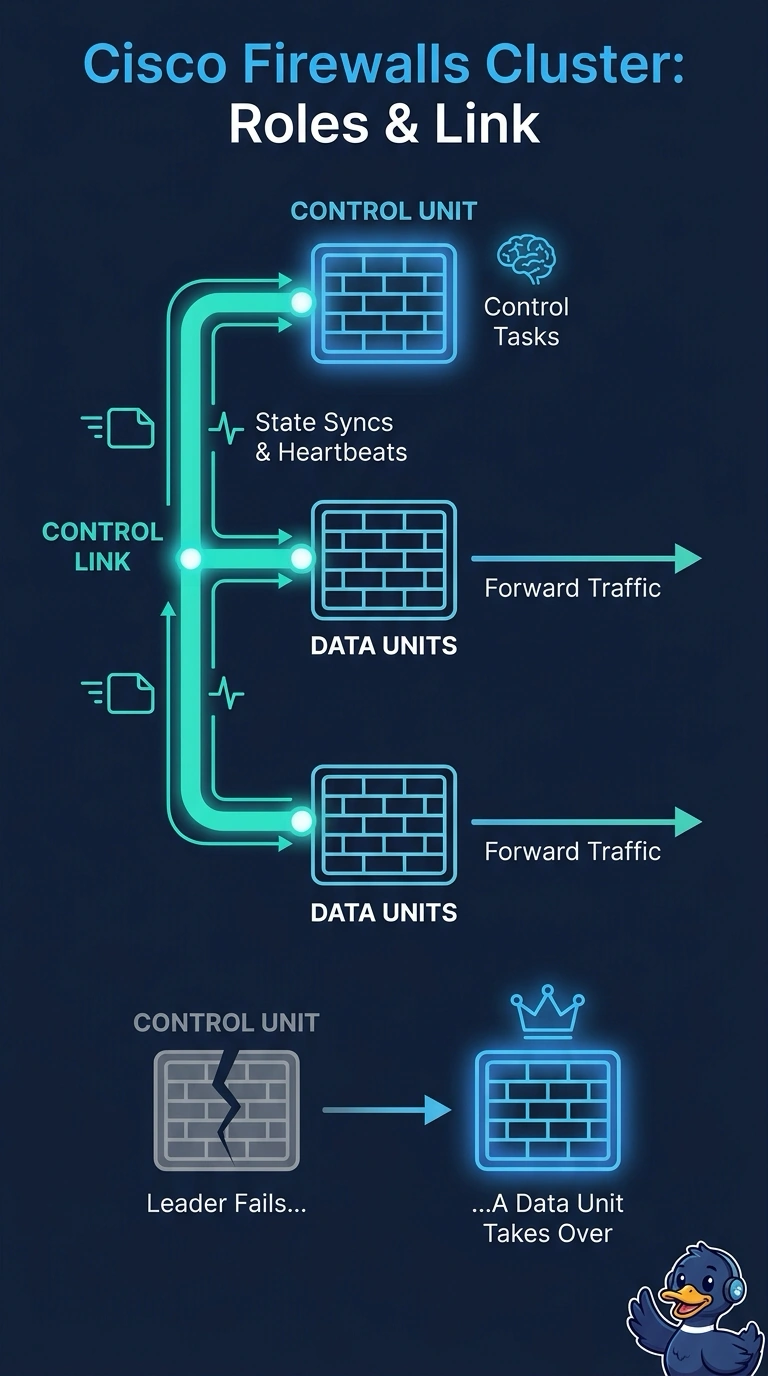
You use a control unit with data units, like a conductor coordinating an orchestra, to boost throughput and present one cluster view in Management Center. A dedicated cluster control link carries heartbeats and session state, so sessions survive a leadership change and cluster chatter stays off your production interfaces.
Full Explanation
An FTD cluster elects one member as the control unit, which owns cluster control duties such as configuration replication and leadership, while every other member is a data unit that forwards production traffic; the role moves when the control unit is lost, so sessions and capacity remain available. Heartbeats, election messages and connection state replication all travel on the cluster control link, a dedicated interface on an isolated subnet, which keeps cluster chatter away from the production interfaces carrying customer traffic. Running eight standalone firewalls behind a load balancer does spread connections and can still be managed from one Management Center, but no state is shared, so an active session dies whenever traffic lands on a different member. Sending heartbeats and state over the data interfaces puts cluster health at the mercy of congestion on the very links you are trying to protect. Pinning the control role to one appliance and letting it forward alone leaves seven idle boxes, so aggregate throughput never grows. Exam caveat: cluster members must run identical software in the same firewall mode, and clustering cannot be combined with HA. Practical check: after the cluster forms, confirm the control unit, watch state replication on the control link, and verify connections spread across data units.