
A security audit lists four FMC findings: management access is open to a whole subnet, backups exist only on the appliance, updates are applied whenever someone remembers, and the FMC rejects external TLS peers' certificates as outside their validity window while its logs arrive an hour out of step. The engineer must clear the finding that breaks certificate validation and time correlation first. Which FMC time configuration should they correct first to clear the certificate and correlation finding?
Select an answer to reveal the explanation.
Short Explanation
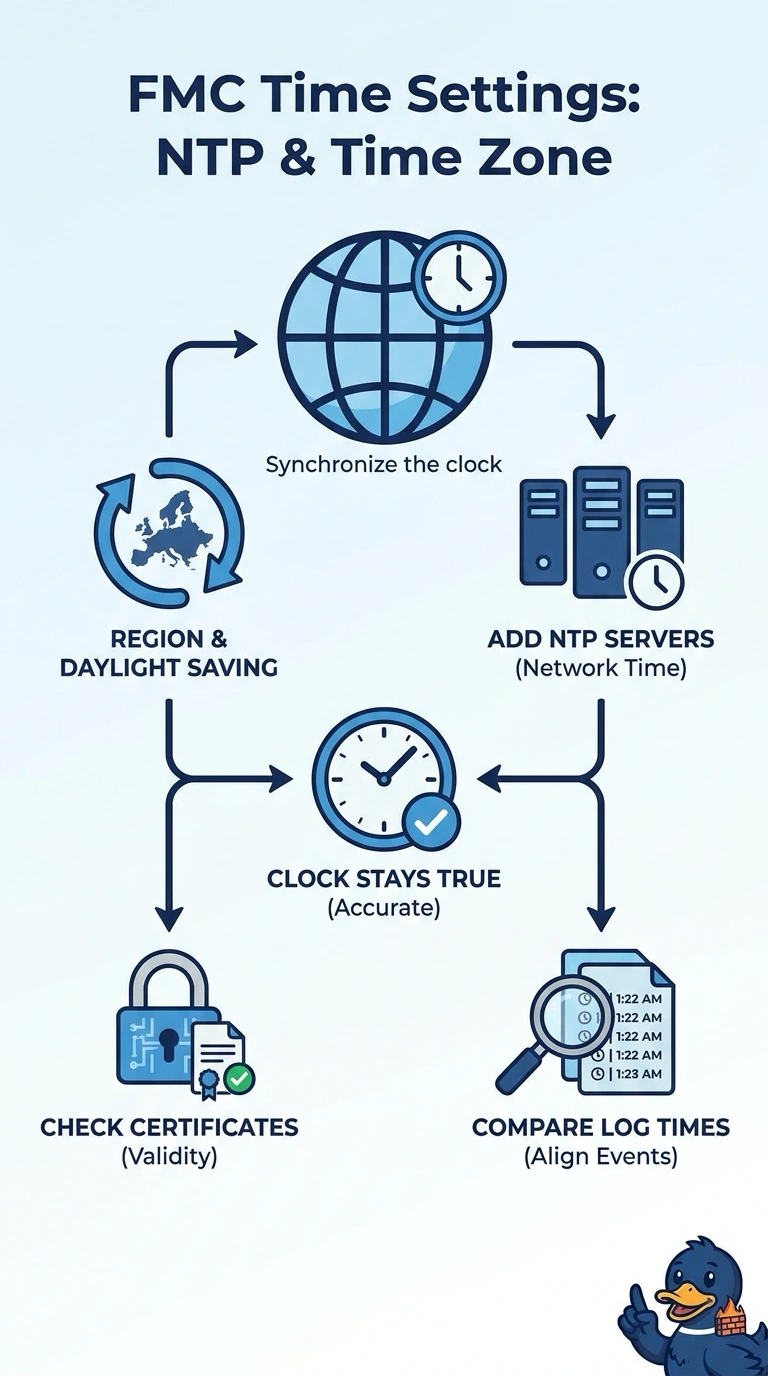
Certificate checks and log correlation both depend on the FMC keeping accurate time, so you’ll want to correct its time configuration first. Set its regional time zone with daylight-saving rules and use NTP as the authoritative clock source, giving it a trusted, consistent reference.
Full Explanation
The FMC’s own clock should synchronize with a reliable NTP source, and its regional time zone should include daylight-saving rules where applicable. Accurate system time lets the FMC evaluate external TLS certificate validity windows correctly, while consistent timestamps support correlation with other systems. Using authoritative NTP with a fixed-offset time zone that never applies daylight saving can leave displayed local time an hour out during the applicable season and undermine timestamp correlation. Setting the regional time zone but adjusting the clock manually when drift appears is not continuous, authoritative synchronization; drift can recur between corrections and affect certificate checks or log comparisons. Configuring authoritative NTP and time-zone settings on managed FTDs while leaving the FMC clock unchanged does not correct the FMC time identified in the finding. The appropriate configuration is the FMC’s regional time zone, including daylight-saving rules, with NTP servers as its authoritative clock source. Exam caveat: time zones affect displayed timestamps, while certificate validity is evaluated against the system’s actual clock; changing a time zone alone will not fix a genuinely inaccurate clock. Practical check: confirm that the FMC reports NTP synchronization, then compare an FMC event timestamp with a trusted reference and verify that daylight-saving rules apply when relevant.