
A payroll server must be reachable only by members of the Finance Active Directory group. The site has 400 domain-joined laptops, runs without any ISE deployment, and holds a strict policy that authentication prompts and added connection delay are unacceptable for these users. The Management Center runs release 7.6 or later with Snort 3 on its devices. Which identity policy configuration supplies the user-to-IP mapping the access rule needs?
Select an answer to reveal the explanation.
Short Explanation
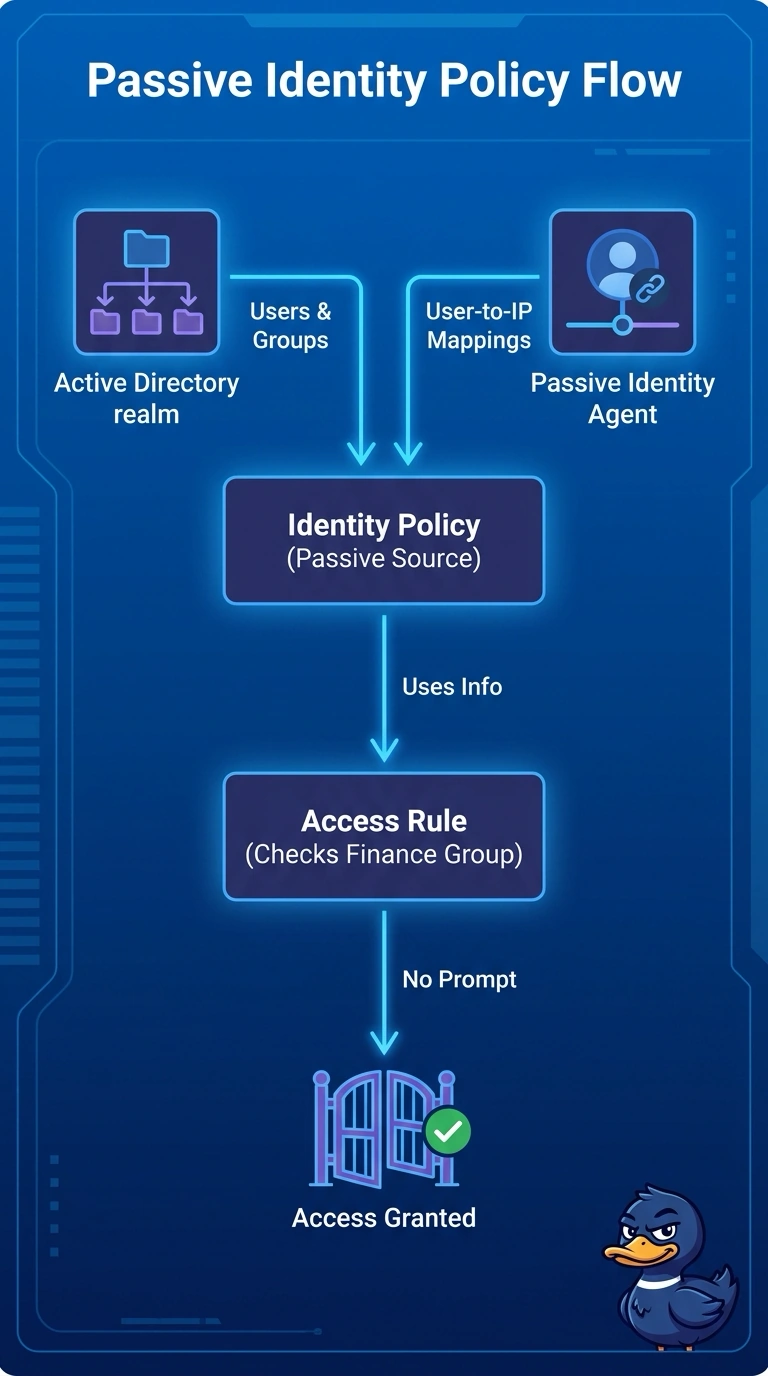
Your access rule can match Finance membership only when the firewall knows which user is behind each address. Configure the AD realm for group lookup and the Passive Identity Agent for passive user-to-IP mappings, so you can enforce the rule without prompting users or adding an authentication exchange. This fits your no-ISE deployment and strict delay requirement.
Full Explanation
The configuration separates group authorization from identity acquisition: the AD realm lets Firepower resolve Finance membership, while the Passive Identity Agent passively supplies user-to-IP mappings from the Active Directory environment, without requiring ISE. This supports a user-aware access rule without asking laptop users to authenticate again or inserting an authentication exchange into their traffic. Kerberos single sign-on can identify domain users without a visible prompt, but it still performs an authentication exchange when identity is needed and can add connection delay. 802.1X with RADIUS accounting and AD group authorization is a common identity-aware access design, and its records can inform downstream policy, but endpoint authentication during network access can delay setup, which this site forbids. Certificate-based authentication can identify an employee without a password prompt and support AD-backed authorization, but Firepower must perform certificate authentication and validation to establish that identity, so it does not meet the no-added-delay requirement. Exam caveat: passive mapping avoids an interactive exchange, but it is not instantaneous and can become stale if logoff or address-change events are missed. Practical check: confirm that the Passive Identity Agent can reach the domain controllers, resolve Finance membership, and report current laptop user-to-IP mappings in Firepower before testing the payroll rule.